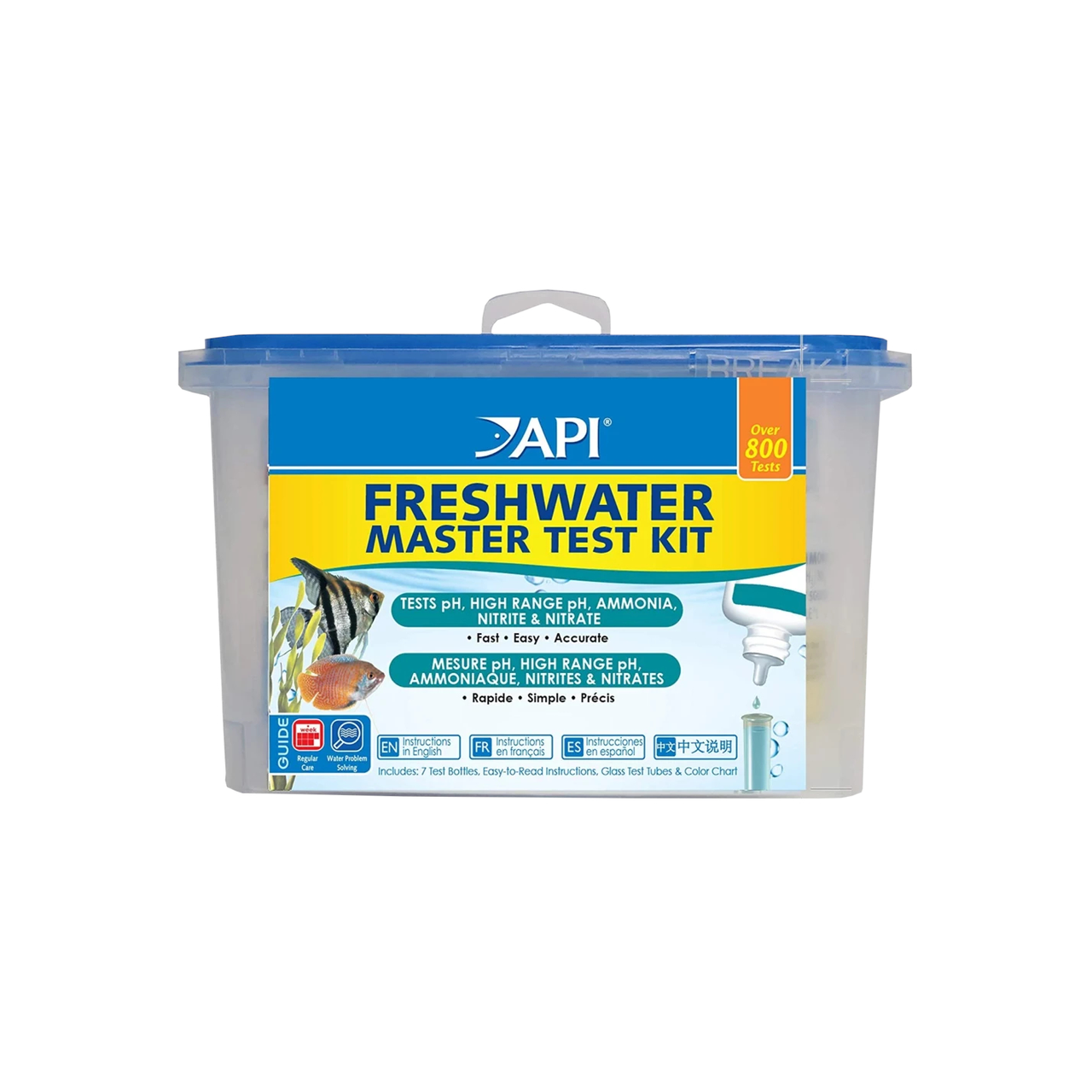
API Freshwater Master Test Kit
The API Freshwater Master Test Kit is one of the most useful pieces of equipment you can own for a freshwater aquarium.
It allows you to test the key water parameters involved in aquarium cycling, fish health and long-term water quality using liquid reagents rather than relying on how clear the water looks.
The kit tests:
-
Ammonia
-
Nitrite
-
Nitrate
-
pH
-
High-Range pH
If you're setting up a new aquarium, troubleshooting sick fish or simply want to know what's actually happening in your water, this is one of the first test kits we'd recommend.
Why Do I Need an Aquarium Test Kit?
Most serious aquarium water problems are completely invisible.
Water can look crystal clear while still containing dangerous levels of:
-
Ammonia
-
Nitrite
-
Nitrate
-
An unsuitable pH
Testing takes the guesswork out of aquarium care.
Instead of saying:
"The fish don't look right — maybe I'll add something to the water."
you can actually test the aquarium, identify the problem and make a sensible decision.
Who Is It For?
We recommend the API Freshwater Master Test Kit for:
-
New aquarium owners
-
Tropical freshwater aquariums
-
Coldwater aquariums
-
Planted aquariums
-
Goldfish tanks
-
Cichlid aquariums
-
Anyone cycling a new aquarium
-
Anyone investigating fish-health problems
-
Customers who want more information than basic test strips provide
If you own a freshwater aquarium, this is the sort of product we'd rather see sitting in your cupboard before something goes wrong.
What Does It Test?
Ammonia
Ammonia is produced by fish waste, uneaten food and decomposing organic material.
In a properly established aquarium, beneficial bacteria should process ammonia as part of the nitrogen cycle.
In a normal established aquarium, we want ammonia at 0 ppm.
Any measurable ammonia is something we'd investigate.
Nitrite
Nitrite is produced as bacteria begin processing ammonia.
It is also toxic to fish and should normally read:
0 ppm
Ammonia and nitrite are particularly important when cycling a new aquarium because they tell you whether the biological filter is actually establishing.
Nitrate
Nitrate is the later product of the aquarium nitrogen cycle.
Unlike ammonia and nitrite, some nitrate is normal in many established aquariums.
However, nitrate can gradually accumulate through:
-
Fish waste
-
Feeding
-
Organic material
-
Infrequent water changes
The appropriate nitrate level depends on your livestock and aquarium, but the goal is generally to prevent it from continually building up.
Regular water changes and sensible stocking are two of the main tools used to control nitrate.
pH
pH tells you how acidic or alkaline the aquarium water is.
Different fish prefer different ranges.
Rather than constantly trying to force your aquarium toward a magical pH number, we generally recommend understanding:
A stable suitable pH is generally much better than constantly chasing numbers with chemicals.
High-Range pH
The kit also includes a High-Range pH test for water that sits above the range covered by the standard pH test.
This is particularly useful for harder, more alkaline aquariums such as many:
-
African cichlid setups
-
Livebearer aquariums
-
Hard-water tanks
Use the pH test that covers the expected range of your aquarium water.
Why Is Testing So Important When Cycling a New Aquarium?
When an aquarium is brand new, the biological filter has not yet developed a large enough population of beneficial bacteria to reliably process fish waste.
During the cycle:
Ammonia rises → bacteria process it into nitrite → another group of bacteria processes nitrite into nitrate.
A test kit lets you actually watch this process happening.
For a cycled aquarium, the key result we're looking for is:
Ammonia: 0 ppm
Nitrite: 0 ppm
rather than simply deciding the aquarium must be cycled because it has been running for a particular number of days.
How Do I Use the API Master Test Kit?
Each test has slightly different instructions, so always follow the supplied API booklet for the individual parameter you're testing.
The general process is:
-
Rinse the test tube.
-
Fill it to the required water level.
-
Add the specified reagent drops.
-
Mix the sample as directed.
-
Wait the required amount of time.
-
Compare the sample against the supplied colour chart.
-
Record the result if you're monitoring a developing problem.
-
Dispose of the tested water.
-
Rinse the tube immediately after testing.
Do not pour tested water back into the aquarium.
Important Nitrate Test Tip
Follow the nitrate-test shaking instructions properly.
This is one we see catch people out.
Some of the API reagents need to be shaken vigorously before testing. If the reagent isn't properly mixed, you can end up with a result that doesn't accurately represent what's happening in the aquarium.
Don't just give the bottle two lazy shakes and call it good.
Follow the instructions on the nitrate test carefully, including the required shaking and timing.
If you've got a nitrate result that seems completely inconsistent with the aquarium, we'd repeat the test properly before making major changes.
Read the Colours in Good Light
Comparing liquid tests against colour charts isn't always easy.
We recommend:
-
Use bright neutral/white lighting
-
Avoid strongly coloured room lighting
-
Hold the tube against the appropriate part of the chart
-
Look at the colour from the direction specified by the instructions
-
If you're unsure between two readings, don't pretend you can identify an exact number that isn't clearly visible
For aquarium management, knowing you're approximately between two values is often more useful than falsely believing you've measured something to laboratory precision.
Rinse the Test Tubes Straight Away
Once you've finished testing:
rinse the tubes immediately with clean water.
Don't leave reagent sitting inside them until next week.
API specifically recommends rinsing the tubes after testing to prevent residue or staining building up on the inside of the tube.
We also recommend keeping the tubes clean and dedicated to aquarium testing rather than using them for anything else.
Don't Mix Up the Caps
If you're running several tests at once, keep your equipment organised.
Avoid transferring reagent residue from one test into another.
A simple routine helps:
-
Test.
-
Rinse.
-
Keep each tube and cap clean.
-
Start the next test.
It only takes a tiny amount of contamination to make you question whether a strange result is real.
How Often Should I Test My Aquarium?
API recommends weekly testing as a good general routine.
We'd test more frequently when:
-
Cycling a new aquarium
-
Adding a significant number of fish
-
Fish suddenly look unwell
-
Fish are gasping or behaving abnormally
-
A filter has stopped working
-
You've had an unexplained fish death
-
You've significantly disturbed or replaced filter media
-
You suspect overfeeding
-
You've recently treated the aquarium
An established aquarium with stable results may not require obsessive daily testing.
But if something looks wrong, test the water first.
What Should My Results Be?
For a normal established freshwater aquarium:
Ammonia:
0 ppm
Nitrite:
0 ppm
Nitrate:
Some nitrate is common; monitor it and prevent excessive accumulation.
pH:
Depends on your fish species and source water.
The important part is interpreting results in the context of the aquarium rather than treating every parameter as though there is one perfect number for every fish.
Test Strips vs API Master Test Kit
Test strips are useful because they're fast and convenient.
We like them for:
But the API Freshwater Master Test Kit gives you dedicated liquid tests for ammonia, which is particularly important when cycling and troubleshooting freshwater aquariums.
If someone is setting up their first serious aquarium and asks us which testing system we'd rather they own, we'd choose the Master Test Kit.
What Isn't Included?
The Freshwater Master Test Kit does not test everything you may eventually want to know.
It does not include dedicated tests for:
API sells separate GH/KH testing, and other specialist test kits are available if your aquarium requires more detailed water analysis.
For most beginner and community aquariums, though, the Master Test Kit covers the parameters we'd consider most urgent.
What's Included?
The kit includes:
It contains separate solutions for the different tests rather than disposable single-use strips.
Simply Fish Recommends
If you've spent hundreds or thousands of dollars on an aquarium and livestock, owning a proper water test kit is cheap insurance.
The most common conversation we want to avoid is:
"My fish are dying. What product should I add?"
followed by:
"I don't know what my ammonia or nitrite is."
Our first recommendation in that situation is usually:
Test the water.
A bottle of water conditioner, bacteria or medication might be useful — but only if we're treating the actual problem.
For a brand-new aquarium we'd pair this with products such as Seachem Prime and Stability, then use the test kit to monitor whether the biological filtration is genuinely establishing.
The aquarium doesn't care how many days the bacteria bottle says you've been dosing.
The test results tell you what's actually happening.
FAQ
What does the API Freshwater Master Test Kit test?
It tests ammonia, nitrite, nitrate, pH and high-range pH.
Does it test ammonia?
Yes. This is one of the biggest reasons we recommend it for new aquariums.
Does it test GH and KH?
No. GH and KH require a separate test kit.
Can I use it while cycling an aquarium?
Yes. This is one of its most useful applications because you can monitor ammonia and nitrite as the biological filter develops.
What should ammonia be in an established aquarium?
0 ppm.
What should nitrite be?
0 ppm.
Is nitrate supposed to be zero?
Not necessarily. Some nitrate is common in established freshwater aquariums. The important thing is monitoring it and preventing excessive accumulation.
How often should I test my aquarium?
API recommends weekly testing for routine monitoring, with more frequent testing when cycling or troubleshooting a problem.
Are liquid tests better than strips?
Both have uses. Strips are quick and convenient, while the Master Test Kit provides dedicated liquid testing including ammonia and is our preference for cycling and troubleshooting.
Why is my nitrate reading suspiciously low?
Repeat the test carefully and make sure you've followed the reagent-shaking instructions properly. Insufficient mixing can affect the test.
Should I pour the tested water back into my aquarium?
No. Dispose of the sample after testing and rinse the tube.
How do I clean the test tubes?
Rinse them with clean water immediately after testing so reagent residue isn't left sitting inside them.
Can I use the Freshwater Master Test Kit on a marine aquarium?
It's designed for freshwater aquariums. API produces dedicated Saltwater and Reef Master Test Kits for marine systems.
Is this something every aquarium owner should have?
For freshwater aquariums, we think it's one of the most useful pieces of maintenance equipment you can own.