
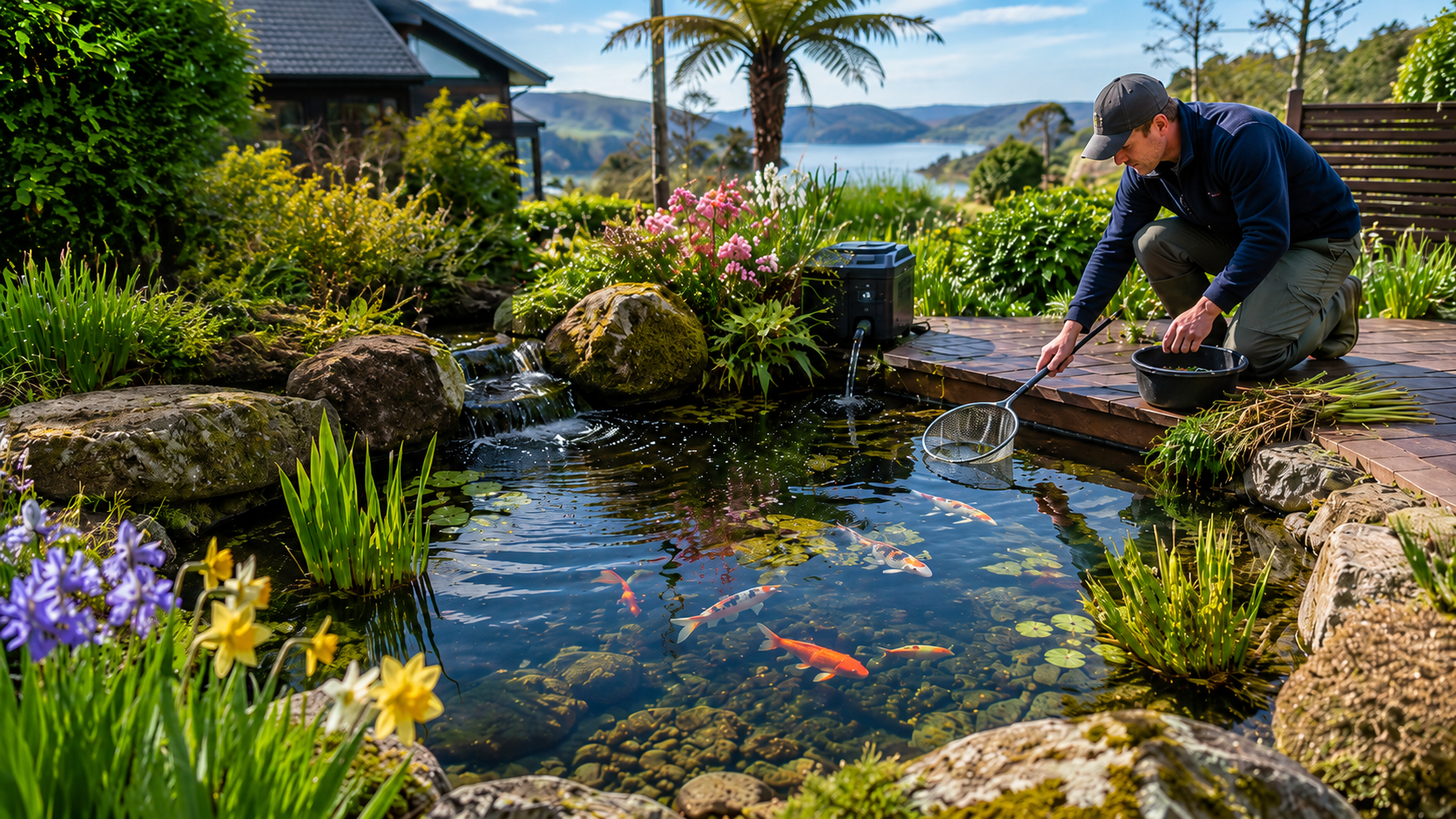
How to Prepare Your Pond for Spring in New Zealand
After a cold New Zealand winter, spring is when outdoor ponds really start coming back to life.
Water temperatures begin to rise, fish become more active, aquatic plants start growing again and unfortunately algae often decides it's ready for spring too.
Late winter and early spring are therefore a great time to give your pond some attention before everything is growing, spawning and feeding heavily. New Zealand pond specialists also recommend getting major seasonal maintenance out of the way around August rather than disturbing the pond later once fish and plants become more active.
The good news is you usually don't need to completely strip a pond down and start again.
A proper spring pond service is mostly about removing accumulated waste, checking your equipment, getting water moving properly again and preparing the pond for the warmer months ahead.
Here's how we'd tackle it at Simply Fish.
1. Remove Leaves, Sludge and Winter Debris
Start with the obvious stuff.
Over winter, outdoor ponds can accumulate:
-
Fallen leaves
-
Dead plant material
-
Fish waste
-
Uneaten food
-
Dirt
-
Sludge
-
Organic debris around rocks and waterfalls
Remove as much physical debris as you reasonably can before reaching for treatments.
Use a net to remove leaves and larger material and clean excessive sludge from areas where it has built up.
Don't worry about making the pond clinically sterile.
A pond is a living ecosystem, not a swimming pool.
The goal is simply to remove excessive waste before warmer temperatures accelerate biological activity.
For stubborn organic buildup, we stock products such as API Pond Ecofix Sludge Destroyer and API Pond-Zyme Sludge Destroyer, which are designed to help break down accumulated organic pond waste.
For rocks, waterfalls, liners and other surfaces with heavy organic buildup, API Pond & Waterfall Cleaner is another option in our pond-care range.
Simply Fish Tip
Treatments can help, but don't use a bottle as an excuse to ignore a pond full of rotting leaves.
Remove what you can physically first. Then let the treatment help with what's left.
2. Check Your Pond Pump
Your pump is basically the heart of most filtered garden ponds.
Before spring really gets going, check that:
-
The pump starts reliably
-
Water flow is strong
-
The intake isn't blocked
-
The impeller is clean
-
Hoses aren't kinked
-
Fittings aren't leaking
-
Fountain or waterfall outlets are flowing correctly
If the flow seems noticeably weaker than you remember, don't automatically assume you need a new pump.
Turn it off, remove it safely and check the intake and impeller first.
A surprisingly small amount of debris can make a significant difference to flow.
If your existing pump is undersized, unreliable or you're setting up a new pond, our Pond One Pondmaster MK II range covers models from approximately 600L/hr through to 4,800L/hr and can be used for pond circulation, fountains, waterfalls and filtration setups.
You can also explore our full Pond Pumps range for different pond sizes and applications.
Don't Choose a Pond Pump on Litres Alone
Consider:
-
Pond volume
-
Required flow
-
Filter requirements
-
Waterfall height
-
Hose length
-
Head height
-
Number of bends and restrictions
A pump might say 4,000L/hr on the box, but it won't necessarily deliver that same flow after pushing water uphill through several metres of hose.
3. Check and Clean Your Pond Filter
Once your pump is sorted, move onto the filter.
Spring is a good time to inspect:
-
Filter sponges
-
Filter pads
-
Biological media
-
UV equipment
-
Hoses
-
Inlets and outlets
Remove excessive physical waste from mechanical filter media so water can flow through it properly.
But don't go overboard and try to make every piece of biological media look brand new.
Established biological filtration relies on beneficial bacteria.
Our preference is to clean the filter enough to restore flow without unnecessarily stripping the biological system back to zero.
If your filter hasn't been running over winter or you've significantly disturbed the biological media, Pond Stability can be used to help establish or support pond biofiltration.
Explore our Pond Filters range if you're upgrading or building a new filtration system.
4. Deal With Green Water Before Summer
As temperatures and sunlight increase, algae can become much more noticeable.
One of the most frustrating pond problems is green water - when microscopic free-floating algae turns the pond into what looks like pea soup.
Before throwing treatments at it, check the fundamentals:
-
Is filtration adequate?
-
Is the pump moving enough water?
-
Is there a huge amount of decaying organic material?
-
Is the pond heavily exposed to sunlight?
-
Are aquatic plants beginning to grow strongly?
-
Is the pond overstocked or heavily fed?
Aquatic plants can play an important role in pond ecology, and NZ pond specialists note that healthy plant coverage can help compete for nutrients as spring growth begins.
For persistent green water, a UV clarifier can be extremely useful.
The Pond One ClearTec UV Clarifier range uses UV-C to target free-floating green-water algae and is available in several sizes, with different maximum flow rates depending on the model.
A UV clarifier works particularly well when paired with proper filtration so the affected algae and debris can then be physically removed from the water.
We also stock pond water treatments including API Pond Microbial Algae Clean and API Pond Algaefix for specific algae-management situations. Always identify the problem first and follow the product directions carefully.
5. Check Your Pond Water Before Adding More Fish
A pond looking clear doesn't automatically mean the water quality is perfect.
If fish are already present, keep an eye on:
-
Ammonia
-
Nitrite
-
Nitrate
-
pH
-
General fish behaviour
-
Water clarity
This becomes particularly important as temperatures increase and fish start eating more.
More food means more waste.
More waste means more demand on your biological filtration.
If you're topping up or performing a significant water change with chlorinated tap water, use a proper water conditioner.
Pond Prime is specifically designed for pond use and conditions new water by dealing with chlorine and chloramine.
If the pond has cloudy water caused by fine suspended particles, API Pond Accu-Clear is designed to bind small particles together so filtration can capture them more effectively.
You can find these and other products in our Pond Water Treatments collection.
Simply Fish Tip
If something looks wrong with your fish, we'd much rather you test the water before adding random treatments.
Clear water can still have a water-quality problem.
If you're local we provide free water testing so feel free to bring in a sample!
6. Start Feeding Pond Fish Gradually
As pond temperatures increase, fish become more active and begin looking for food more frequently.
Don't go straight from minimal winter feeding to throwing huge handfuls of food into the pond.
Increase feeding gradually as the fish become active and the water warms.
New Zealand pond guidance generally recommends reducing or stopping feeding as water temperatures become cold because fish metabolism slows; feeding increases again as conditions warm.
Feed an amount the fish will actually eat rather than allowing large amounts to sink and decay.
We stock JBL PROPOND All Seasons Sticks, a floating pond food designed for feeding across a broad seasonal temperature range.
You can also browse our full Pond Fish Food range for Goldfish and other freshwater pond fish.
Don't Overfeed Because the Fish Look Hungry
Goldfish are very convincing.
They'll happily swim to the surface and act as though nobody has fed them since 2009.
Don't believe everything they tell you.
Feed sensible portions and monitor how quickly the food disappears.
Anything sitting around uneaten eventually becomes another water-quality problem.
7. Get Your Pond Plants Ready
Spring is also when many aquatic plants begin putting on new growth.
Check existing pond plants and remove:
-
Dead leaves
-
Rotting stems
-
Excessive old growth
-
Damaged plant material
If plants have been in the same pot for years, spring can also be a good opportunity to divide or repot them where appropriate.
For potting aquatic plants such as water lilies, Daltons Premium Aquatic Mix is a much better choice than ordinary garden potting mix.
Nutrient-rich aquatic planting media should generally be kept inside aquatic plant pots rather than spread loose across the pond floor.
Cap the planting mix with suitable gravel or coarse material to help keep it contained once submerged.
You can find aquatic planting media and suitable options in our Pond Substrates collection.
Healthy pond plants aren't just decorative either. They provide habitat and use nutrients from the water as they grow. New Zealand pond guidance recommends maintaining substantial aquatic plant coverage as part of a balanced water garden.
8. Check Water Movement and Oxygenation
Warmer water and increased biological activity mean good water movement becomes increasingly important.
Look for stagnant areas where very little water movement occurs.
Your pond doesn't necessarily need to look like a washing machine, but circulation helps move water through filtration and reduces stagnant zones.
Depending on your setup, water movement can come from:
-
Pond pumps
-
Filter returns
-
Fountains
-
Waterfalls
-
Air pumps and diffusers
If you have fish, good circulation and aeration become particularly important through warmer weather.
This is another reason we recommend sorting out pumps, filters and air equipment before the hottest part of summer arrives.
9. Don't Completely Tear the Pond Apart Unless You Need To
One of the easiest mistakes is deciding that spring cleaning means:
Drain everything. Scrub everything. Replace everything. Start again.
Usually, that's unnecessary.
If the pond is fundamentally healthy, we'd rather make sensible improvements while preserving the established biological system.
Remove excessive waste.
Service the equipment.
Clean clogged mechanical filtration.
Trim the plants.
Check water quality.
Then let the pond settle.
There's a big difference between maintaining a pond and repeatedly resetting it.
Simply Fish Spring Pond Checklist
Before pond season gets underway, run through this list:
-
Remove accumulated leaves and debris
-
Remove excessive sludge
-
Trim dead plant material
-
Check the pond pump
-
Clean the pump intake and impeller
-
Check hoses and fittings
-
Service mechanical filtration
-
Preserve established biological media
-
Check UV equipment
-
Test pond water
-
Condition any new tap water
-
Increase fish feeding gradually
-
Repot or divide aquatic plants where required
-
Check water circulation
-
Watch for early algae problems
-
Make sure fish look active and healthy
If you get those basics right now, pond maintenance through spring and summer becomes considerably easier.
Getting Your Pond Ready for Spring?
Simply Fish stocks a growing range of pond equipment and supplies including:
-
Pond Pumps
-
Pond Filters
-
Pond Water Treatments
-
Pond Fish Food
-
Pond Substrates
along with products from Pond One, API, Seachem, JBL and other pond-care brands. Our current Pond department includes dedicated collections for pumps, filtration, treatments, food and substrates.
Whether you're bringing an established pond out of winter or getting a new garden pond ready for the warmer months, getting the equipment, water quality and maintenance sorted early gives you the best foundation for the season ahead.
Shop the complete Simply Fish Pond range online with nationwide NZ delivery, or visit us in Christchurch if you need help choosing the right pump, filter, food or water treatment for your pond.