
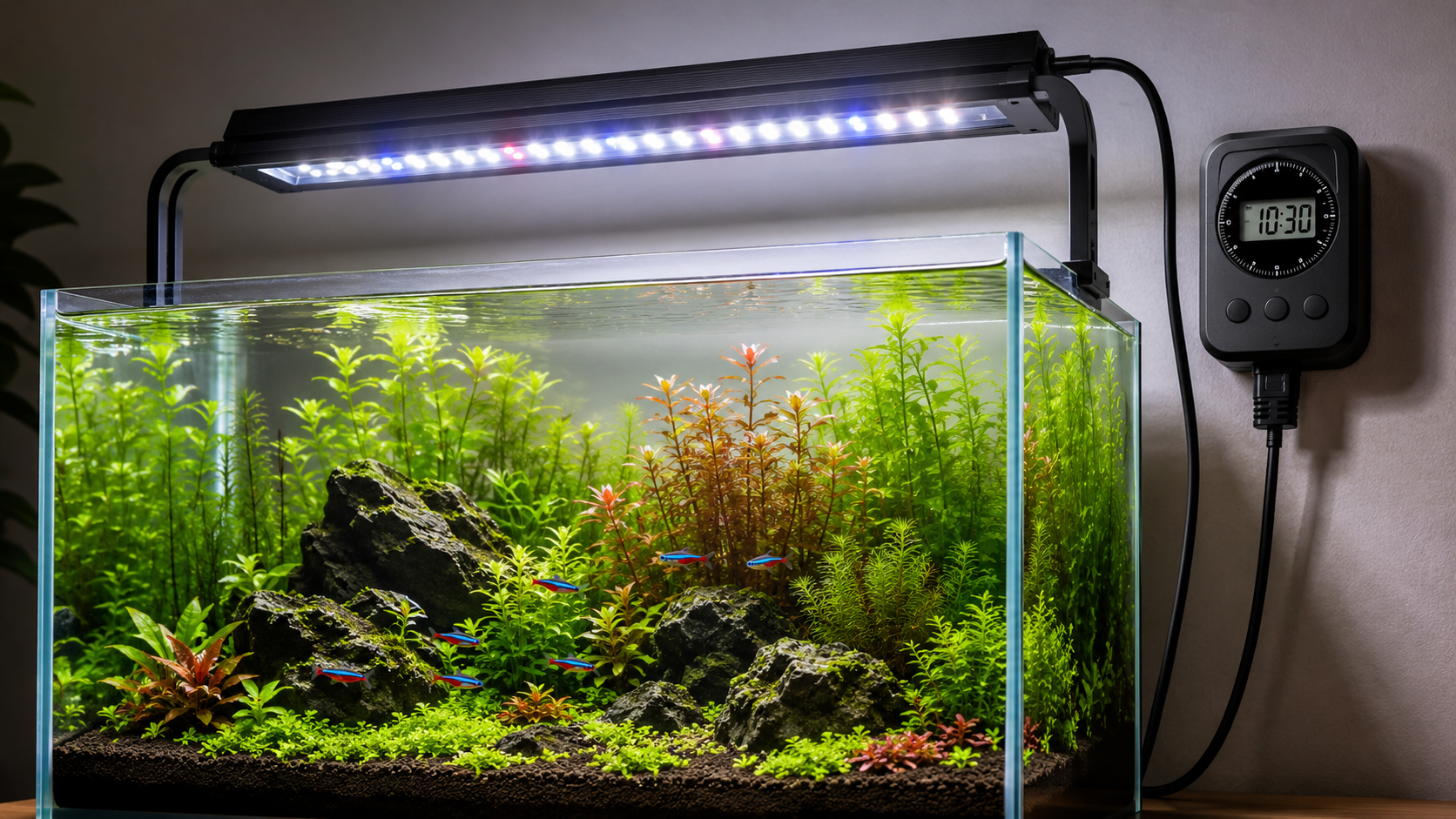
How Long Should Aquarium Lights Stay On?
Most aquarium lights should stay on for approximately six to eight hours per day.
For a new aquarium or a tank experiencing algae problems, starting closer to six hours is usually sensible. A mature planted aquarium with healthy growth may be able to run for eight hours or longer, but more light does not automatically create better plant growth.
The correct lighting schedule depends on:
- The strength of the aquarium light
- The types of plants being grown
- Whether the aquarium uses injected CO₂
- The availability of plant nutrients
- Aquarium depth
- Existing algae growth
- Whether the light intensity can be adjusted
At Simply Fish, one of the most common issues we see is not a lack of light. It is an aquarium receiving too much light or light that cannot be properly controlled.
Quick aquarium lighting guide
| Aquarium type | Suggested starting duration |
|---|---|
| Newly established aquarium | 6 hours |
| Low-tech planted aquarium | 6–8 hours |
| Established planted aquarium | 7–8 hours |
| High-tech planted aquarium with CO₂ | 7–9 hours |
| Aquarium experiencing algae | Reduce to around 6 hours while investigating |
| Aquarium with artificial plants only | As needed for viewing, generally no more than 6–8 hours |
These are starting points rather than strict rules.
A powerful light running for six hours can provide considerably more light than a weak light running for ten hours. You therefore need to consider both duration and intensity.
Why aquarium lights should not stay on all day
Aquarium plants need light for photosynthesis, but they cannot use unlimited light.
When an aquarium receives more light than its plants can effectively use, algae often takes advantage of the excess.
Leaving aquarium lights on for ten, twelve or fourteen hours can contribute to:
- Green algae on the glass
- Algae growing over plant leaves
- Black beard algae
- Hair algae
- Plants becoming shaded by algae
- An aquarium that becomes harder to balance
- Faster evaporation and unnecessary power use
Longer lighting periods are not a substitute for correct fertilisation, suitable CO₂ availability or healthy plants.
A plant that is struggling because it lacks nutrients will not necessarily recover when the light is left on longer. In many cases, stronger or longer lighting can make the imbalance more obvious by accelerating algae growth.
Is six hours of aquarium light enough?
Six hours is often enough for a newly established aquarium or a low-tech planted tank.
It is also a useful starting point when algae is already becoming a problem.
Starting at six hours allows you to observe how the aquarium responds before gradually increasing the lighting period.
If plants are growing well and algae remains manageable, you can increase the duration in small steps. Add approximately 30 minutes at a time, then give the aquarium time to respond before making another change.
Do not move immediately from six hours to ten hours because the plants appear to be growing slowly.
Slow growth may be caused by:
- A naturally slow-growing plant
- Insufficient nutrients
- Limited CO₂
- Recent planting or plant transition
- Incorrect planting
- Poor water circulation
- Unsuitable light intensity
Our guide to Why Are My Aquarium Plants Dying? covers these problems in more detail.
Is eight hours of aquarium light too much?
Eight hours is a common and reasonable lighting period for many established aquariums.
However, eight hours can still be too much when:
- The light is extremely powerful
- The tank has only a few plants
- Most plants are slow-growing
- The aquarium does not use CO₂
- Nutrient availability is inconsistent
- Algae is already established
- The aquarium receives additional sunlight
- The light runs at full intensity
This is why there is no single perfect lighting duration for every aquarium.
Two tanks can both run their lights for eight hours and receive completely different amounts of usable light.
Light duration and light intensity are not the same thing
Lighting duration describes how long the light is switched on.
Lighting intensity describes how powerful the light is while operating.
Both matter.
A common mistake is reducing the lighting period while leaving an extremely powerful light at full intensity. This may help, but it does not always solve the underlying problem.
A better approach is to use a light that allows you to control:
- Brightness
- Daily schedule
- Individual colour channels
- Sunrise and sunset periods
- Overall output
This control allows the lighting to be matched to the aquarium rather than forcing the aquarium to cope with one fixed setting.
Why a controllable aquarium light is important
Many aquarium kits include lights that are either fully on or fully off.
These lights can grow plants, but the owner may have no way to reduce the intensity when the output is too strong.
This can be frustrating because the only available adjustment is shortening the lighting period.
A controllable light gives you another option.
Instead of choosing between full power and complete darkness, you can run the light at an appropriate percentage for the plants and aquarium.
This is useful because different tanks have different requirements.
For example:
- An Anubias and Java fern aquarium may require relatively modest lighting.
- A densely planted aquascape may benefit from stronger output.
- A tank without injected CO₂ may need lower intensity.
- A deep aquarium may require more output than a shallow tank.
- A tank experiencing algae may need both reduced duration and reduced intensity.
Control is often more important than simply buying the brightest aquarium light available.
Why we recommend Chihiros aquarium lighting
At Simply Fish, Chihiros is one of our most popular lighting ranges.
We recommend these lights because the range gives aquarium owners more control over the way their tank is lit.
Depending on the model, Chihiros lighting can allow you to adjust the schedule, brightness and colour output using the My Chihiros app.
This makes it easier to:
- Set a consistent daily schedule
- Reduce excessive brightness
- Gradually increase intensity
- Create sunrise and sunset periods
- Adjust how fish and plant colours appear
- Match the output to low-tech or high-tech plant growth
- Make changes without replacing the entire light
A controllable light cannot fix every aquarium problem on its own. However, it gives you the tools to correct the lighting instead of being stuck with a fixed output.
Shop the Chihiros Lighting range
Chihiros B Series
The Chihiros B Series is our value-focused recommendation for customers wanting better plant growth and control without immediately moving into the most expensive WRGB ranges.
It is suitable for many beginner and intermediate planted aquariums.
The B Series is a good option when you want:
- Strong value for money
- Better plant-growing performance than many basic kit lights
- A clean, modern design
- Adjustable mounting options
- App control when used with the compatible Chihiros Commander
The optional Bluetooth controller is important for customers who want to control the light through the My Chihiros app.
Without suitable control, even a good aquarium light may be more difficult to balance.
Shop Chihiros B Series Lighting
You can also check out our youtube video on the B-Series
Chihiros WRGB II
The Chihiros WRGB II is designed for planted aquariums where strong growth, colour rendering and control are priorities.
It uses red, green and blue lighting channels to bring out the colour of aquarium plants, fish and hardscape.
The WRGB II is suited to:
- Heavily planted aquariums
- Aquascapes
- Customers wanting stronger colour
- Medium-tech and high-tech planted tanks
- More demanding aquarium plants
- Tanks where precise control is valuable
A powerful WRGB light should not automatically be run at full intensity.
For many aquariums, especially tanks without injected CO₂, beginning at a reduced output is more sensible. You can then gradually increase the intensity while monitoring plant growth and algae.
Shop Chihiros WRGB II Lighting
Chihiros WRGB II Slim
The Chihiros WRGB II Slim offers WRGB colour and app control in a slimmer, lower-output format than the full WRGB II.
It is a strong option for customers who want:
- Excellent fish and plant colour
- A sleek light
- App-based control
- Good planted-tank performance
- Less output than the full WRGB II
- A more affordable route into Chihiros WRGB lighting
The WRGB II Slim can be particularly useful when the full WRGB II would provide more output than the aquarium needs.
It is still a capable planted-tank light, and its output should be adjusted to suit the tank rather than automatically set to maximum.
Shop Chihiros WRGB II Slim Lighting
Chihiros Universal WRGB
The Chihiros Universal WRGB is especially useful for aquarium owners who want controllable WRGB lighting while retaining a covered aquarium.
It is a popular replacement option for compatible Juwel aquariums because it can fit into the existing aquarium setup rather than requiring the tank to be converted into an open-top design.
At Simply Fish, we often see Juwel Rio owners struggling with lighting that is overpowering for their particular planted setup.
The issue is not necessarily that the original light is poor. It is that the owner may have limited control over its intensity.
The Chihiros Universal WRGB gives the user greater control through the My Chihiros app.
This allows you to:
- Reduce the intensity
- Set the lighting schedule
- Adjust colour output
- Create gradual sunrise and sunset periods
- Match the output to the plants
- Improve the way fish and plants look
The Universal WRGB comes with a higher price tag, but it can solve a number of lighting-control problems while significantly improving the appearance of the aquarium.
It is our second-most-popular lighting range in store.
Always check the correct model and size for your aquarium before purchasing.
Shop Chihiros Universal WRGB Lighting
Which Chihiros aquarium light should you choose?
Choose the B Series when:
- You want strong value for money
- You have a beginner or intermediate planted aquarium
- You want to upgrade from basic lighting
- Full WRGB colour control is not essential
- You want optional app control through a compatible controller
Choose the WRGB II Slim when:
- You want strong plant and fish colour
- You want built-in app control
- You want a slimmer and less powerful WRGB option
- You have a low-tech or medium-tech planted aquarium
- The full WRGB II would be excessive for your setup
Choose the WRGB II when:
- You have a heavily planted aquarium
- You want stronger output
- You grow more demanding plants
- You want detailed WRGB control
- You use or plan to use injected CO₂
- Aquascaping performance is a priority
Choose the Universal WRGB when:
- You have a compatible covered aquarium
- You want to replace a Juwel-style light
- You want app control without removing the aquarium lid
- You need better control over excessive lighting
- You want improved plant and fish colour
The most expensive or powerful light is not automatically the correct choice.
The best light is the one that fits the aquarium and gives you enough control to match the needs of the plants.
Suggested lighting schedules
New low-tech planted aquarium
- Duration: 6 hours
- Intensity: Low to moderate
- CO₂: Not injected
- Goal: Allow plants to establish without encouraging excessive algae
Established low-tech planted aquarium
- Duration: 7–8 hours
- Intensity: Moderate
- CO₂: Not injected
- Goal: Consistent plant growth with manageable algae
High-tech planted aquarium
- Duration: 7–9 hours
- Intensity: Moderate to high
- CO₂: Injected and stable
- Goal: Faster growth, stronger colour and more demanding plants
Aquarium with algae problems
- Duration: Approximately 6 hours
- Intensity: Reduced
- CO₂: Check stability if used
- Goal: Reduce lighting pressure while identifying the underlying issue
Do not treat these as permanent universal settings.
Observe the aquarium and adjust gradually.
Should aquarium lights be split into two periods?
Some fishkeepers run the aquarium light for several hours in the morning, switch it off during the middle of the day, then run it again in the evening.
This is sometimes called a split photoperiod or siesta schedule.
It can make the aquarium visible before and after work while keeping the total daily lighting period manageable.
For example:
- 7:00 am to 10:00 am
- Off during the day
- 5:00 pm to 9:00 pm
This gives seven total hours of light.
A split schedule can work, but it is not necessary for most aquariums. A single consistent lighting period is simpler and is usually where we recommend beginners start.
Should aquarium lights stay on at night?
No. Aquarium lights should not stay on throughout the night.
Fish and plants benefit from a regular dark period.
Leaving the main aquarium light running overnight can:
- Disrupt the natural day-and-night cycle
- Stress fish
- Encourage algae
- Waste electricity
- Make the aquarium harder to balance
If your light has a moonlight setting, use it sparingly.
A dim moonlight effect can be useful for viewing the aquarium briefly, but it should not remain brightly illuminated all night.
The aquarium should still receive a proper period of darkness.
Does sunlight affect the aquarium light schedule?
Yes.
An aquarium near a bright window may receive several hours of natural light before the aquarium light is even switched on.
This additional light contributes to the total daily lighting exposure and can encourage algae.
Signs that natural sunlight may be contributing include:
- Algae appearing heavily on one side of the tank
- Green water
- Rapid algae growth during summer
- Algae concentrated near the window
- The tank becoming noticeably brighter at certain times
Where possible, avoid placing an aquarium in direct sunlight.
If the tank cannot be moved, reduce the artificial lighting duration or intensity and consider using blinds or curtains during the brightest period.
How to adjust aquarium lighting without causing problems
Make one change at a time.
Step 1: Set a consistent timer
Choose a daily start and finish time.
Consistency is more useful than manually switching the light on and off at different times each day.
Step 2: Start conservatively
Begin at approximately six hours for a new aquarium.
Use a moderate intensity rather than immediately running a powerful light at full output.
Step 3: Watch new plant growth
Healthy new leaves are a better indicator than older leaves that may have been damaged or grown above water.
Step 4: Monitor algae
A small amount of algae is normal.
Rapidly increasing algae can indicate that the aquarium is receiving more light than the plants can currently use.
Step 5: Adjust gradually
Increase or reduce the lighting duration by approximately 30 minutes at a time.
When adjusting intensity, make small changes and allow the tank time to respond.
Step 6: Review nutrients and CO₂
Do not assume every plant problem is caused by light.
Plants also need suitable nutrients, carbon dioxide and stable conditions.
Read our guides to:
- Why Are My Aquarium Plants Dying?
- 10 Best Easy Aquarium Plants for Beginners
- Seachem Flourish Explained
Common aquarium lighting mistakes
Leaving the light on whenever someone is home
The aquarium should follow a consistent schedule rather than the household’s waking hours.
Set the light to run during the hours when you are most likely to enjoy the aquarium.
Running a powerful light at 100%
Full output is not automatically the best setting.
Many planted aquariums perform better when a powerful light is reduced to match the available nutrients and CO₂.
Increasing light when plants grow slowly
Slow growth may be completely normal for plants such as Anubias, Java fern and Cryptocoryne.
More light can create algae without significantly improving their growth.
Changing the schedule every few days
Aquariums need time to respond.
Constantly changing the duration and intensity makes it difficult to determine which setting is working.
Ignoring sunlight
Natural light through a window still counts.
Treating algae as proof that the light is faulty
Algae can be caused by several interacting factors.
The light may be too strong, but nutrients, CO₂, plant health, waste and circulation should also be considered.
Frequently asked questions
How many hours should a planted aquarium light be on?
Most planted aquarium lights should run for approximately six to eight hours each day.
New aquariums should generally begin near the lower end of that range.
Is ten hours of light too much for an aquarium?
Ten hours may be excessive for many beginner and low-tech aquariums, especially when the light is powerful or the aquarium receives natural sunlight.
Reduce the duration if algae is spreading rapidly.
Can aquarium plants grow with six hours of light?
Yes. Many easy aquarium plants can grow successfully with six hours of suitable light each day.
The strength and quality of the light also matter.
Can too much aquarium light cause algae?
Excessive lighting duration or intensity can contribute to algae growth, particularly when plants cannot use all the available light because nutrients or CO₂ are limited.
Should I turn my aquarium light off when algae appears?
Do not permanently leave the aquarium in darkness.
Reduce the lighting duration and intensity while identifying the underlying cause. Healthy plants still need a consistent source of light.
Is blue light bad for aquarium plants?
Blue wavelengths are used by plants, but leaving a bright blue moonlight setting on throughout the night can extend the effective lighting period and contribute to algae.
Use nighttime effects briefly and allow the aquarium a proper dark period.
Is an app-controlled aquarium light worth it?
An app-controlled light can be worthwhile because it gives you better control over the schedule and intensity.
This is particularly helpful with powerful planted-tank lighting or aquariums that are experiencing recurring algae.
What is the best aquarium light for a Juwel aquarium?
For compatible covered Juwel aquariums, the Chihiros Universal WRGB is a strong premium option because it can replace the existing light while providing app-based control.
Confirm model and size compatibility before purchasing.
The best aquarium lighting schedule
For most aquariums, begin with six to eight hours of light each day.
The key is not finding one perfect number. It is creating a consistent schedule and matching the light intensity to the plants, nutrients and CO₂ available.
When choosing an aquarium light, control is extremely important.
A powerful light that can be reduced and scheduled is often easier to manage than a fixed-output light that gives you no flexibility.
The Chihiros B Series, WRGB II, WRGB II Slim and Universal WRGB cover different budgets and aquarium setups while giving fishkeepers far more control over their lighting.