
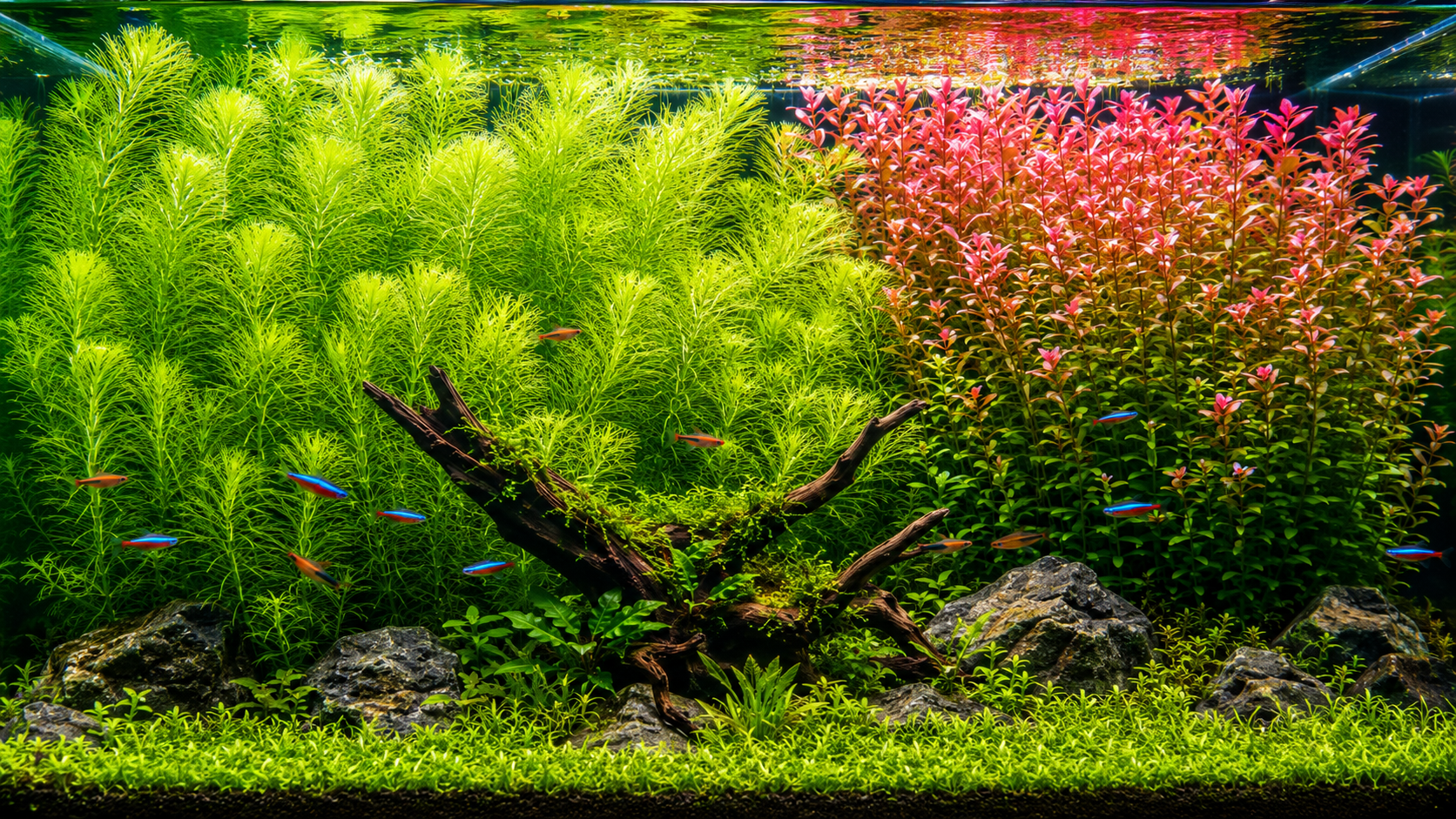
10 Best Easy Aquarium Plants for Beginners
The best aquarium plants for beginners are hardy species such as Ambulia, Anubias, Java fern, Vallisneria and Hygrophila. These plants are relatively forgiving, can grow without injected CO₂ and do not require advanced planted-tank equipment.
Starting a planted aquarium can seem complicated, but you do not need an expensive lighting system, a CO₂ kit or years of experience to grow healthy plants.
The most important thing is choosing the right species.
At Simply Fish, we regularly help customers who want a natural-looking planted aquarium without turning plant care into a full-time job. The ten plants below are among the easiest options we recommend for beginners.
You can also browse our full range of live aquarium plants or start with our Beginner Aquarium Plant Pack.
What makes an aquarium plant beginner-friendly?
A good beginner aquarium plant should:
- Grow without injected CO₂
- Tolerate a reasonable range of water conditions
- Grow under standard aquarium lighting
- Recover from common beginner mistakes
- Be straightforward to plant and maintain
- Be readily available in New Zealand
“Easy” does not mean that a plant can survive without light or nutrients. Aquarium plants are living organisms, and even hardy species need suitable conditions.
However, the following plants are considerably more forgiving than delicate or demanding aquascaping plants.
Quick comparison
| Aquarium plant | Growth rate | Light requirement | CO₂ required? | Best position |
|---|---|---|---|---|
| Ambulia | Fast | Low to moderate | No | Background |
| Anubias | Slow | Low | No | Hardscape |
| Java fern | Slow | Low to moderate | No | Hardscape |
| Vallisneria | Moderate to fast | Moderate | No | Background |
| Hygrophila polysperma | Fast | Low to moderate | No | Background |
| Blue Hygrophila | Fast | Moderate | No | Midground or background |
| Rotala rotundifolia | Moderate to fast | Moderate | No | Background |
| Moneywort | Moderate | Moderate | No | Midground or background |
| Cryptocoryne wendtii | Slow to moderate | Low to moderate | No | Midground |
| Amazon sword | Moderate | Moderate | No | Midground or background |
1. Ambulia
Ambulia is one of the easiest and fastest-growing aquarium plants available to beginners.
It produces soft, feathery green growth and can quickly create a dense background in a tropical aquarium. Its fine leaves also provide shelter for small fish and fry.
Ambulia can grow without injected CO₂ and adapts to a range of aquarium conditions. Moderate lighting will normally produce denser, more compact growth, while insufficient light can cause it to become tall and stretched.
Why Ambulia is good for beginners
- Fast-growing
- Easy to trim and replant
- Does not require CO₂
- Helps fill empty space quickly
- Provides cover for fish and fry
To propagate Ambulia, cut a healthy section from the top of a stem and plant the cutting back into the substrate.
Because it grows quickly, regular trimming may be required. This is generally an advantage for beginners because healthy new growth makes it easier to tell whether the plant is doing well.
2. Anubias
Anubias is one of the best low-maintenance aquarium plants.
It has thick, dark-green leaves and grows well under relatively low light. It is particularly useful in aquariums containing fish that may disturb or damage more delicate plants.
Unlike most aquarium plants, Anubias should normally be attached to driftwood, rocks or aquarium decorations.
Do not bury the Anubias rhizome
The thick horizontal section at the base of the plant is called the rhizome. This must remain exposed to the water.
Burying the rhizome under gravel or substrate can cause it to rot.
The roots can be secured to wood or rock using aquarium-safe glue, cotton thread or fishing line. Over time, the roots will begin gripping the surface.
Why Anubias is good for beginners
- Extremely hardy
- Grows under low light
- Does not require CO₂
- Needs very little trimming
- Can be attached to wood or rock
- Suitable for nano tanks and larger aquariums
The main disadvantage is its slow growth. Because the leaves remain in place for a long time, they can collect algae when exposed to excessive light.
3. Java fern
Java fern is another hardy plant that grows well attached to driftwood or rocks.
Like Anubias, Java fern grows from a rhizome that should not be completely buried. It is therefore an excellent option for aquariums without a nutrient-rich substrate.
Java fern is available in several varieties, including standard Java fern and needle-leaf Java fern.
Why Java fern is good for beginners
- Tolerates low to moderate light
- Does not require injected CO₂
- Can grow without planted-tank substrate
- Requires little maintenance
- Works well in many tropical aquariums
Java fern may occasionally produce small new plants on the tips or undersides of mature leaves. Once these plantlets develop roots, they can be separated and attached elsewhere in the aquarium.
Newly added Java fern can sometimes lose older leaves while adjusting to a different aquarium. Remove badly damaged leaves and watch for healthy new growth from the rhizome.
4. Vallisneria
Vallisneria is a grass-like aquarium plant that works particularly well along the back or sides of an aquarium.
Once established, it spreads by producing runners underneath or across the substrate. These runners develop into new plants, allowing Vallisneria to form a dense underwater background.
Twisted Vallisneria is a popular variation with curled or spiralled leaves.
Why Vallisneria is good for beginners
- Spreads naturally through runners
- Does not require injected CO₂
- Creates an effective background
- Provides shelter for fish
- Suitable for many tropical community tanks
Plant Vallisneria with its roots beneath the substrate but keep the crown—the point where the leaves meet the roots—above the surface.
Vallisneria may temporarily lose leaves after being moved. This does not always mean the plant has died. As long as the crown and roots remain healthy, new leaves may emerge once the plant adjusts.
5. Hygrophila polysperma
Hygrophila polysperma is a fast-growing stem plant and one of the most forgiving choices for a beginner planted aquarium.
It grows in a wide range of conditions and can quickly fill the background of a tank. Its rapid growth also makes it useful for absorbing available nutrients from the water.
Why Hygrophila polysperma is good for beginners
- Very fast-growing
- Easy to trim
- Easy to propagate
- Does not require injected CO₂
- Tolerates a range of lighting conditions
As with other stem plants, Hygrophila can be propagated by cutting off the upper section and planting it back into the substrate.
It will need regular trimming once established. Without trimming, it can reach the surface and shade slower-growing plants underneath it.
6. Blue Hygrophila
Blue Hygrophila is another adaptable stem plant suitable for beginner aquariums.
Despite its name, it usually appears green under standard aquarium conditions. Its colour, leaf shape and growth pattern can vary depending on light, nutrients and whether it has previously been grown above or below water.
It is a useful choice for adding taller, broader-leaved growth to the middle or back of an aquarium.
Why Blue Hygrophila is good for beginners
- Fast-growing
- Hardy and adaptable
- Easy to propagate from cuttings
- Does not require injected CO₂
- Adds height and texture
Blue Hygrophila can grow quickly once it settles in. Trim the upper growth when it becomes too tall and replant the healthiest cuttings.
Some older leaves may change or fall away after the plant is introduced. This is often part of its adjustment to being fully submerged.
7. Rotala rotundifolia
Rotala rotundifolia is a good introduction to colourful stem plants.
Under basic lighting, it will commonly remain predominantly green. With stronger lighting and suitable nutrition, its upper growth may develop warmer orange or reddish tones.
It is slightly more demanding than Ambulia or Hygrophila, but it is still forgiving enough for many beginner planted aquariums.
Why Rotala rotundifolia is good for beginners
- Relatively fast-growing
- Easy to propagate
- Can grow without injected CO₂
- Offers the potential for additional colour
- Creates a dense background when regularly trimmed
Plant several stems together while leaving enough room for light and water to move between them.
Regularly cutting and replanting the tops will help create a bushier appearance. Leaving the plant completely untrimmed will often produce tall, less compact growth.
8. Moneywort
Moneywort is a sturdy stem plant with rounded green leaves.
Its simple growth pattern makes it easy for beginners to plant, trim and understand. It can be planted in groups through the middle or back of an aquarium.
Moneywort generally prefers moderate light but does not require injected CO₂ to survive and grow.
Why Moneywort is good for beginners
- Straightforward to plant
- Easy to trim and replant
- Distinctive rounded leaves
- Does not require injected CO₂
- Suitable for many community aquariums
Space the stems slightly apart when planting them. Packing them too tightly can prevent sufficient light and water movement from reaching the lower leaves.
When a stem becomes too tall, cut the healthy upper portion and plant it back into the substrate.
9. Cryptocoryne wendtii
Cryptocoryne wendtii—or Crypt wendtii—is a hardy, slow-growing plant suited to the middle of an aquarium.
It is available in several colour forms and can tolerate lower lighting than many stem plants. Once established, it requires relatively little trimming or ongoing maintenance.
Why Cryptocoryne wendtii is good for beginners
- Tolerates low to moderate light
- Slow, manageable growth
- Does not require injected CO₂
- Works well in the midground
- Available in different colours and forms
Cryptocoryne plants are well known for “crypt melt.” This is when some or all existing leaves break down after the plant is moved or aquarium conditions change.
Crypt melt can look alarming, but it does not necessarily mean the roots have died. Remove deteriorating leaves, avoid repeatedly moving the plant and allow time for new growth to appear.
Cryptocoryne feeds heavily through its roots. Root tabs can help when it is planted in plain gravel or an inert substrate.
10. Amazon sword
Amazon sword plants produce large leaves and can become an impressive feature in medium or large aquariums.
They are generally hardy, but they need more root nutrition than plants such as Anubias or Java fern. For that reason, Amazon swords perform best in a nutrient-rich substrate or with aquarium root tabs.
Why Amazon swords are good for beginners
- Hardy once established
- Produces large, attractive leaves
- Does not require injected CO₂
- Makes an effective feature plant
- Provides cover for fish
Amazon swords can eventually become too large for small tanks, so check the mature size before buying one.
Yellowing, pale or transparent leaves can indicate that the plant is not receiving enough nutrition. In aquariums with plain gravel or sand, place root tabs near the roots and replenish them according to the product instructions.
Do beginner aquarium plants need CO₂?
None of the plants in this guide require an injected CO₂ system to be grown successfully.
All aquarium plants use carbon dioxide, but fish respiration, biological activity and gas exchange naturally provide a limited amount. An injected CO₂ system can increase growth and allow more demanding plants to thrive, but it is not essential for a basic beginner planted aquarium.
The better approach for a new fishkeeper is to begin with hardy plants, sensible lighting and a straightforward fertilising routine.
You can consider adding CO₂ later if you want faster growth, denser aquascaping or more demanding plant species.
Do easy aquarium plants need fertiliser?
Easy aquarium plants still need nutrients.
Fish waste and food provide some nutrition, but these sources may not supply everything plants need. The correct fertiliser depends partly on how each plant feeds.
Water-column feeders
Plants such as Anubias, Java fern and many stem plants can absorb nutrients directly from the water. A suitable liquid aquarium fertiliser can support their growth.
Root feeders
Plants such as Amazon swords and Cryptocoryne obtain a significant portion of their nutrition through their roots. Root tabs are useful when these plants are growing in plain sand or gravel.
Avoid adding several different fertilisers without understanding what each one provides. More fertiliser does not automatically mean faster or healthier growth.
How much light do beginner aquarium plants need?
A consistent lighting schedule is more important than leaving the aquarium light on for as long as possible.
For a newly planted beginner aquarium, starting with approximately six to eight hours of light each day is generally sensible. Use a timer so the light turns on and off at the same times.
If algae begins spreading rapidly, increasing the lighting period is unlikely to help. Check the total duration, light intensity, plant health and nutrient balance before making changes.
Different tanks require different adjustments, so observe how your plants respond rather than chasing one universal setting.
Why do new aquarium plants sometimes melt?
Many aquarium plants are commercially grown with their leaves above water. When placed fully underwater, their existing leaves may not be ideally adapted to submerged growth.
The plant can shed these older leaves while producing new underwater growth.
Melting can also be caused by:
- Damage during transport
- Sudden changes in water conditions
- Insufficient light
- Nutrient deficiencies
- A buried rhizome or crown
- Repeatedly moving the plant
- Poor root health
Remove leaves that are completely deteriorating, but avoid discarding the entire plant while its roots or rhizome remain healthy.
The appearance of new leaves is usually a better indicator of success than the condition of the original leaves.
Common beginner aquarium-plant mistakes
Choosing plants purely by appearance
Some of the most attractive aquarium plants require powerful lighting, injected CO₂ and precise fertilisation.
Check a plant’s requirements before buying it rather than assuming every species has similar needs.
Burying Anubias or Java fern rhizomes
The roots can be attached or lightly positioned, but the rhizome should remain exposed.
Expecting instant growth
Some plants, especially Anubias and Cryptocoryne, grow slowly. Slow growth does not necessarily indicate poor health.
Leaving the light on too long
Excessive lighting can encourage algae without making plants grow faster.
Ignoring root nutrition
Root-feeding plants can struggle in plain gravel or sand unless they receive root tabs or another suitable source of substrate nutrition.
Constantly moving plants
Many aquarium plants need time to establish. Replanting them every few days can damage their roots and delay recovery.
The easiest way to start a planted aquarium
You do not need ten different plant species immediately.
A simple beginner setup might include:
- Ambulia or Hygrophila at the back
- Cryptocoryne through the middle
- Anubias or Java fern attached to driftwood
- Vallisneria along one side
- An Amazon sword as a larger feature plant
This creates different heights and textures while keeping the plant requirements manageable.
For an easier starting point, the Simply Fish Beginner Aquarium Plant Pack contains a selection of easy-care plants chosen from the healthy plants we have available.
Shop our Beginner Aquarium Plant Pack
You can also browse our full range of live aquarium plants available for delivery around New Zealand or collection from our Christchurch store.
Our advice for new planted-tank owners
Start simple.
Choose several hardy plants, use a timer on your aquarium light and give the plants time to adjust. Do not immediately react to every damaged leaf by changing the lighting, fertiliser, substrate and water conditions all at once.
When several things are changed together, it becomes impossible to identify what helped or caused the problem.
A beginner aquarium does not need to resemble a competition aquascape. Healthy, uncomplicated plant growth is a much better first goal.
Once you can grow these hardy species consistently, you will have a far better foundation for trying carpeting plants, red plants, stronger lighting or injected CO₂.
Frequently asked questions
What is the easiest aquarium plant to keep alive?
Anubias and Java fern are two of the easiest aquarium plants to keep because they tolerate relatively low light, do not require injected CO₂ and can be attached directly to aquarium hardscape.
Ambulia and Hygrophila are also excellent choices for beginners who want faster growth.
What aquarium plants grow without CO₂?
Beginner-friendly plants that can grow without injected CO₂ include Anubias, Java fern, Ambulia, Vallisneria, Hygrophila, Rotala rotundifolia, Moneywort, Cryptocoryne and Amazon swords.
Their growth may be faster with added CO₂, but a pressurised system is not required.
Can aquarium plants grow in ordinary gravel?
Many aquarium plants can grow in ordinary aquarium gravel.
Stem plants can be planted directly into it, while Anubias and Java fern are better attached to wood or rocks. Heavy root-feeding plants such as Amazon swords and Cryptocoryne may need root tabs when grown in inert gravel.
What is the best aquarium plant for low light?
Anubias, Java fern and Cryptocoryne are among the best beginner plants for lower-light aquariums.
Low light does not mean no light. These plants still need an appropriate aquarium light and consistent daily schedule.
How many plants should a beginner aquarium have?
There is no fixed number because plants vary significantly in size.
It is generally better to begin with enough plants to create several healthy groups rather than buying one stem of many different species. Fast-growing plants can then be trimmed and replanted as the aquarium develops.
Are live plants good for beginner aquariums?
Yes. Live plants create shelter, improve the appearance of an aquarium and use nutrients as they grow.
The key is selecting hardy plants that suit the aquarium’s lighting, substrate and maintenance level.
Start with easy aquarium plants
The best aquarium plants for beginners are not necessarily the most unusual or colourful plants in the shop. They are the plants that can tolerate beginner mistakes and continue producing healthy new growth under straightforward aquarium conditions.
Ambulia, Anubias, Java fern, Vallisneria, Hygrophila, Rotala, Moneywort, Cryptocoryne and Amazon swords are all strong options.
Start with a manageable selection, learn how each plant responds to your aquarium and build from there.