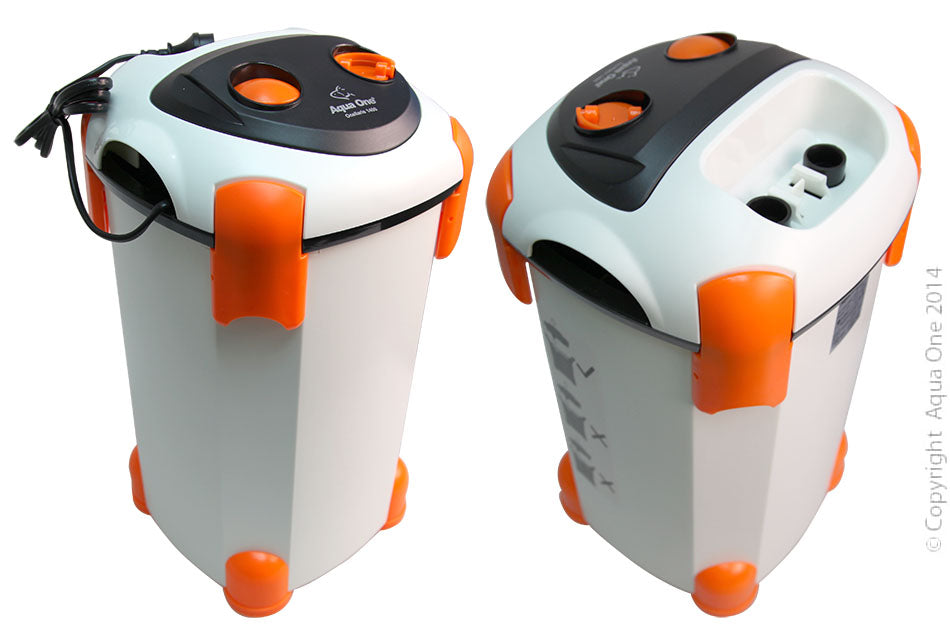
Aqua One Ocellaris 1400 Canister Filter – 1400L/hr
The Aqua One Ocellaris 1400 is a powerful external canister filter designed for medium-to-large aquariums up to approximately 400 litres.
With a maximum flow rate of 1400L/hr and a generous 13-litre filter volume, it provides considerably more filtration capacity than smaller internal filters while keeping the main filter body neatly outside the aquarium.
It comes supplied with mechanical and biological filter media, making it a strong all-round option for tropical, coldwater, planted and marine aquariums.
Why Choose the Ocellaris 1400?
The Ocellaris 1400 makes sense when you want:
Strong external filtration
Plenty of space for filter media
Less equipment visible inside the aquarium
Easy access for filter maintenance
Quiet, energy-efficient operation
Mechanical and biological filtration
The flexibility to customise your filter media
Replacement media and spare parts available
For larger community tanks or planted aquariums, moving to a proper external canister filter also gives you significantly more flexibility than relying on a basic internal filter.
Who Is It For?
We recommend the Ocellaris 1400 for:
Medium-to-large tropical aquariums
Larger community tanks
Planted aquariums
Coldwater aquariums
Marine aquariums
Aquariums where strong biological filtration is required
Customers wanting filtration equipment outside the display tank
Tanks where additional filter-media capacity is useful
Aqua One rates the filter for aquariums up to approximately 400L.
However, we wouldn't automatically choose a filter based purely on its maximum manufacturer rating.
If you've got a heavily stocked 400L aquarium, large messy fish or particularly high filtration requirements, we'd consider stepping up rather than running the filter right at the top of its rated capacity.
Which Ocellaris Model Should I Buy?
Ocellaris 400 400L/hr Up to approximately 100L Best for smaller aquariums.
Ocellaris 850 850L/hr Up to approximately 250L A good option for medium-sized aquariums.
Ocellaris 1400 1400L/hr Up to approximately 400L Our choice for larger aquariums needing significantly more filtration capacity.
If you're sitting right on the boundary between two models, we'd generally lean toward the larger filter — particularly with a heavily stocked aquarium.
Standard Ocellaris 1400 vs Ocellaris 1400 UVC (Important Upgrade)
This is one of the most important decisions in this range — and in most cases, the answer is simple.
Choose the standard Ocellaris 1400 if:
You want strong 1400L/hr canister filtration
You don't need an integrated UV clarifier
You're looking for the lower-cost option
Your main priority is mechanical and biological filtration
Choose the Ocellaris 1400 UVC if:
You want the same powerful 1400L/hr filtration plus built-in UV sterilisation
You've had issues with green water (free-floating algae)
You want clearer, more polished water quality
You want an extra layer of protection against algae blooms and some waterborne pathogens
You want the best all-in-one version of this filter
👉 For only a small jump in price, the 1400 UVC is absolutely worth serious consideration.
The integrated UV clarifier gives you a major advantage in water clarity and algae control without needing any extra equipment in the tank or cabinet.
If you're already investing in a high-capacity external filter, the UVC upgrade is one of the easiest “future-proofing” decisions you can make.
If you're unsure, our general rule is:
If the budget allows, go the 1400 UVC. If not, the standard 1400 is still a very capable filter.
Filter Media Included
The Ocellaris range comes supplied with:
Filter wool
Mechanical filter sponges
Sintered glass biological media
This gives you mechanical and biological filtration straight from the box.
The modular internal design also allows you to customise your filtration media depending on what your aquarium requires.
For example, you may choose to dedicate more space to biological media or add specialised chemical filtration when required.
Important First-Setup Tip
Open the canister and check all of the filter media before switching the filter on.
Make sure you remove any plastic bags or packaging from the biological media inside the filter.
It sounds ridiculously obvious, but customers leaving the media sealed inside the plastic happens more often than you'd think!
Before the first startup:
Open the filter
Remove all packaging
Give appropriate media a quick rinse
Make sure everything is correctly positioned
Reassemble the canister
Then prime and start the filter
Your biological media isn't going to do much for the aquarium while it's still sealed inside a plastic bag.
Quick-Release Tap System
The Ocellaris 1400 uses Aqua One's Quick Release Tap System.
When it's time to service the filter, the tap assembly can be disconnected from the canister, allowing you to remove the filter for cleaning without having to completely dismantle your aquarium plumbing every time.
This makes routine maintenance significantly easier than older or more basic external-filter designs.
Manual Priming
The Ocellaris 1400 also includes a manual primer.
After installation or maintenance, use the primer to draw water into the canister and hoses before starting normal operation.
Getting the filter properly filled with water before startup makes restarting the filter considerably easier and helps reduce trapped air.
How Do I Set It Up?
A basic setup looks like:
Open the canister
Remove all plastic packaging from the filter media
Rinse the supplied media where appropriate
Make sure the media is arranged correctly inside the filter
Position the canister below the aquarium
Install the inlet and outlet pipework
Connect the hoses without creating kinks
Attach the quick-release tap assembly
Use the manual primer to fill the filter with water
Check all connections for leaks
Switch the filter on
Confirm that water is flowing correctly
You may hear some trapped air moving through the filter after initial setup. This should reduce as the air is cleared from the system.
How Often Should I Clean It?
There isn't one fixed schedule that suits every tank.
A lightly stocked planted aquarium may go considerably longer between filter cleans than an aquarium full of large, heavily fed fish.
We'd service the filter when you notice things such as:
Reduced water flow
Dirty filter wool
Heavily clogged sponges
Significant waste inside the canister
Debris accumulating in the hoses
Reduced overall filtration performance
Don't wait until the filter is barely moving water.
Don't Replace All Your Biological Media
This is another mistake we'd like customers to avoid.
Your biological filter media provides surface area for beneficial bacteria.
You generally do not need to throw all of it away every time you clean the filter.
Instead:
Replace disposable fine wool when required
Clean reusable mechanical sponges
Gently rinse biological media when necessary
Keep biological media from drying out during maintenance
Avoid replacing all established biological media at the same time
We'd much rather preserve a healthy established biological filter than make the inside of the canister look brand new every month.
How Should I Clean the Filter Media?
For established biological media, we'd usually rinse it using water removed from the aquarium during a water change rather than aggressively washing everything under untreated chlorinated tap water.
The goal is to remove excessive sludge while preserving the biological filtration.
Mechanical media can generally be cleaned more aggressively because its main job is physically trapping waste.
Specifications
Brand: Aqua One Model: Ocellaris 1400 Maximum Aquarium Volume: Approximately 400L Maximum Flow Rate: 1400L/hr Filter Volume: 13L Power Consumption: 17W Dimensions: 23.5 × 23.5 × 47cm Filter Type: External pressurised canister filter Priming: Manual primer Quick-Release Tap: Yes Filter Media Included: Yes Suitable For: Coldwater, tropical and marine aquariums
Simply Fish Recommends
The Ocellaris 1400 is probably the sweet spot in the Ocellaris range for a lot of larger home aquariums.
You get a large 13L filter body, 1400L/hr stated flow and enough room inside the canister to build a really solid mechanical and biological filtration setup.
For a normal 200–350L freshwater community or planted aquarium, we'd be very comfortable recommending it.
If you're approaching 400L with large, messy fish, we'd start looking at the aquarium more carefully rather than automatically saying:
"It says 400L on the box, so she'll be right."
Stocking level matters.
And if you're comparing this with the 1400 UVC, the key takeaway is simple:
For a small price increase, the UVC version gives you noticeably better water clarity and algae control — making it the smarter long-term upgrade for many setups.
FAQ
What size aquarium is the Aqua One Ocellaris 1400 suitable for? Aqua One rates it for aquariums up to approximately 400 litres.
What is the flow rate? The stated maximum flow rate is 1400L/hr.
How much filter media can it hold? The filter has approximately 13 litres of internal filter volume.
Does it include filter media? Yes. Aqua One supplies filter wool, mechanical sponges and sintered glass biological media.
Do I need to remove the filter media from its plastic packaging? Yes! Open the filter before startup and remove any packaging from the supplied media.
Does it have a primer? Yes. The Ocellaris 1400 uses a manual priming system.
Does it have quick-release taps? Yes.
Is it suitable for planted aquariums? Yes. External canister filtration is particularly useful in planted aquariums.
Can I use it on a marine aquarium? Yes. Aqua One lists the Ocellaris range as suitable for coldwater, tropical and marine aquariums.
Does the standard Ocellaris 1400 have UVC? No. For UV sterilisation, choose the Ocellaris 1400 UVC model.
Is the UVC version worth it? Yes — for a small price increase, it provides improved water clarity and algae control.
Should I buy the Ocellaris 850 or 1400? The 850 is rated up to approximately 250L and the 1400 up to approximately 400L. For larger or heavily stocked tanks, we'd favour the 1400.
Should I replace my biological media every time I clean the filter? No. Established biological media should be preserved wherever possible.
How often should I clean the Ocellaris 1400? When flow reduces or mechanical media becomes visibly clogged.
Estimate shipping
Payment & Security
Your payment information is processed securely. We do not store credit card details nor have access to your credit card information.