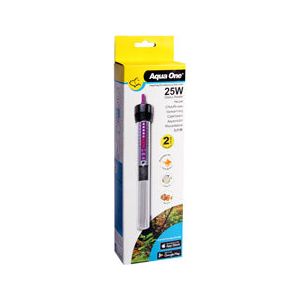
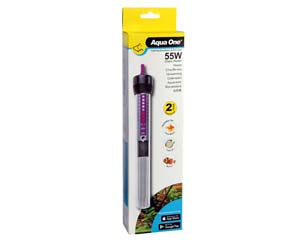
Aqua One Glass Aquarium Heater
The Aqua One Glass Heater is an adjustable, fully submersible aquarium heater designed to maintain a stable water temperature in tropical freshwater and marine aquariums.
Available from 25W through to 300W, there is a model for everything from small tropical aquariums through to larger display tanks.
The adjustable thermostat allows you to select a temperature between approximately 20°C and 34°C, while the indicator light shows when the heater is actively heating the aquarium.
Why Use an Aquarium Heater?
Most tropical aquarium fish require water that is warmer and more stable than normal room temperature.
An aquarium heater helps maintain that temperature automatically.
Once you've selected your desired temperature, the thermostat switches the heating element on and off as required rather than continuously heating the aquarium.
A stable temperature is particularly important because sudden temperature swings can stress aquarium livestock.
Who Is It For?
We recommend the Aqua One Glass Heater for:
-
Tropical freshwater aquariums
-
Community fish tanks
-
Planted aquariums
-
Betta aquariums
-
Cichlid tanks
-
Marine aquariums
-
Customers wanting a straightforward adjustable heater
-
Anyone replacing a basic or failed aquarium heater
It is not normally required for genuine coldwater setups unless the room temperature is dropping below the suitable range for the livestock being kept.
Which Heater Size Should I Buy?
Choosing the correct wattage is one of the most important parts of buying an aquarium heater.
As a general guide for the Aqua One Glass Heater range:
25W
For aquariums up to approximately 25L
55W
For aquariums up to approximately 55L
100W
For aquariums up to approximately 100L
150W
For aquariums up to approximately 150L
200W
For aquariums up to approximately 200L
300W
For aquariums up to approximately 300L
These are useful manufacturer guidelines, but don't treat the litre rating as the only factor.
The heater also has to overcome the difference between your room temperature and desired aquarium temperature.
For example, keeping a tank at 25°C in a warm room is easier than maintaining 25°C in a cold Christchurch garage or poorly heated room during winter.
If you're right on the limit between two heater sizes, we'd generally lean toward the larger option rather than asking a small heater to run constantly.
Heater Size Guide
| Aquarium Size |
Heater We'd Usually Start With |
| Up to 25L |
25W |
| 25–55L |
55W |
| 55–100L |
100W |
| 100–150L |
150W |
| 150–200L |
200W |
| 200–300L |
300W |
For tanks larger than this, or aquariums sitting in particularly cold environments, you may be better using a higher-capacity heating solution or multiple heaters.
What Temperature Should I Set It To?
That depends on the fish you keep.
For many standard tropical community aquariums, somewhere around 24–26°C is common.
However, don't simply set every aquarium to 25°C because it's a tropical tank.
Different species have different preferred temperature ranges.
For example, some tropical fish prefer cooler water while Discus and certain other species are generally kept considerably warmer.
Always choose the temperature based on your actual livestock.
Always Use a Separate Thermometer
Don't rely entirely on the number printed on the heater dial.
We strongly recommend using a separate aquarium thermometer so you can see the actual water temperature.
The heater thermostat controls the heater, but your thermometer tells you what's genuinely happening inside the tank.
After installing or adjusting a heater, check the aquarium temperature over the following day rather than assuming the dial is perfectly calibrated.
Where Should I Put the Heater?
Place the heater somewhere with good water circulation.
Near the filter outlet or another area of consistent water movement is usually ideal because heated water is then distributed throughout the aquarium rather than creating one particularly warm area.
Make sure the heater remains properly submerged according to the manufacturer's instructions.
Avoid positioning it where rocks or heavy décor can fall against the glass.
How Do I Set It Up?
-
Check the heater for any cracks or damage before installation.
-
Attach the suction cups securely.
-
Position the heater somewhere with good water circulation.
-
Make sure it is correctly submerged.
-
Set the thermostat to the temperature required by your livestock.
-
Allow the heater to sit in the aquarium water before operating it.
-
Plug the heater in.
-
Check the actual water temperature with a separate thermometer.
-
Make small adjustments if required.
Once installed, check the temperature regularly rather than assuming the heater will never require attention.
Important Heater Safety
Aquarium heaters combine electricity, glass and water, so treat them properly.
A few rules we'd strongly recommend:
-
Never operate the heater out of water.
-
Keep the heater properly submerged.
-
Unplug the heater before draining water during aquarium maintenance.
-
Never expose a hot heater to air or cold replacement water.
-
If removing the heater, switch it off and allow it time to cool first.
-
Do not use a heater if the glass is cracked or moisture appears inside it.
-
Use a drip loop in the electrical cable.
-
Keep heavy rocks and décor away from the heater.
Aqua One recommends allowing approximately 10–15 minutes for the heater to cool before removing it from the aquarium.
A Very Common Water-Change Mistake
Turn your heater off before doing a water change.
This is one we see more often than we'd like.
If the water level drops and leaves part of a glass heater exposed while it is still operating, the heater can become extremely hot.
Then when cold replacement water hits the hot glass, you dramatically increase the chance of damaging the heater.
Our routine is simple:
Filter off. Heater off. Water change. Refill the aquarium. Then turn everything back on once the equipment is properly submerged again.
Should I Use a Heater Protector?
For many standard community aquariums, it isn't compulsory.
However, a heater guard can be worthwhile in aquariums containing:
-
Large fish
-
Boisterous cichlids
-
Turtles or other suitable aquatic animals
-
Heavy rockwork
-
Fish likely to rest against equipment
-
Situations where the heater could easily be knocked
A heater protector helps reduce direct contact with the heater and can also provide some physical protection for the glass.
One Large Heater or Two Smaller Heaters?
For a normal small or medium aquarium, one appropriately sized heater is usually perfectly practical.
For very large or valuable aquariums, some aquarists prefer using two smaller heaters rather than relying entirely on one large heater.
For example, instead of one very large heater, two units can be positioned at different ends of the aquarium.
This can:
-
Improve heat distribution
-
Provide some redundancy if one heater stops working
-
Reduce reliance on a single heating element
It isn't essential for every aquarium, but it's something we'd consider on larger systems.
Specifications
Brand: Aqua One
Product: Glass Aquarium Heater
Temperature Range: Approximately 20–34°C
Design: Fully submersible glass heater
Thermostat: Adjustable
Heating Indicator: Yes
Suitable For: Tropical freshwater and marine aquariums
Available Sizes
25W – 18.5cm
Recommended aquarium volume: up to approximately 25L
55W – 20.5cm
Recommended aquarium volume: up to approximately 55L
100W – 24.5cm
Recommended aquarium volume: up to approximately 100L
150W – 24.5cm
Recommended aquarium volume: up to approximately 150L
200W – approximately 30cm
Recommended aquarium volume: up to approximately 200L
300W – 35.5cm
Recommended aquarium volume: up to approximately 300L
Simply Fish Recommends
For a straightforward tropical aquarium, the Aqua One Glass Heater is one of those products that doesn't need to be complicated.
Choose the appropriate wattage, put it somewhere with decent flow, set the correct temperature for your fish and verify that temperature with a separate thermometer.
The two mistakes we'd most like customers to avoid are:
1. Buying a heater that's too small.
If you've got a 100L aquarium sitting in a cold room, don't expect a tiny heater designed for a nano tank to keep up.
2. Forgetting to turn the heater off during water changes.
A glass heater sitting half out of the water while it's powered on is asking for trouble.
If your aquarium sits right on the limit between two heater sizes — particularly in a cold Christchurch home over winter — we'd normally lean toward the larger model rather than making the smaller heater work flat out.
FAQ
What wattage aquarium heater do I need?
Aqua One's range broadly matches heater wattage to aquarium volume: 25W for up to 25L, 55W for up to 55L, 100W for up to 100L, 150W for up to 150L, 200W for up to 200L and 300W for up to 300L.
What temperature should I set my aquarium heater to?
That depends on the species you keep. Many tropical community aquariums operate around 24–26°C, but always check the requirements of your actual fish.
Can I fully submerge the Aqua One Glass Heater?
Yes. The Aqua One Glass Heater is designed to be fully submersible.
Does the heater turn itself off?
Yes. The thermostat cycles the heating element on and off as required to maintain the selected temperature.
Why is the light on my heater switching on and off?
That's normal. The indicator shows when the heating element is operating. Once the thermostat reaches the required temperature, the heater switches off until more heat is required.
Do I still need a thermometer?
Yes. We strongly recommend one. A separate thermometer lets you verify the actual aquarium temperature rather than relying solely on the heater dial.
Where should I place the heater?
Put it somewhere with good water movement, such as near the filter outlet, so heat is distributed throughout the aquarium.
Should I turn my heater off during a water change?
Yes. Turn it off before lowering the water level and don't switch it back on until the aquarium has been refilled and the heater is properly submerged.
How long should I wait before removing a heater?
Aqua One recommends switching it off and allowing approximately 10–15 minutes for it to cool before removing it from the aquarium.
Can I use an Aqua One Glass Heater in a marine tank?
Yes. Aqua One lists the range as suitable for tropical freshwater and marine aquariums.
Should I buy a bigger heater than my aquarium needs?
Don't massively oversize it unnecessarily, but if you're right on the boundary between sizes or the aquarium is kept in a particularly cold room, we'd usually favour the next appropriate size rather than undersizing the heater.