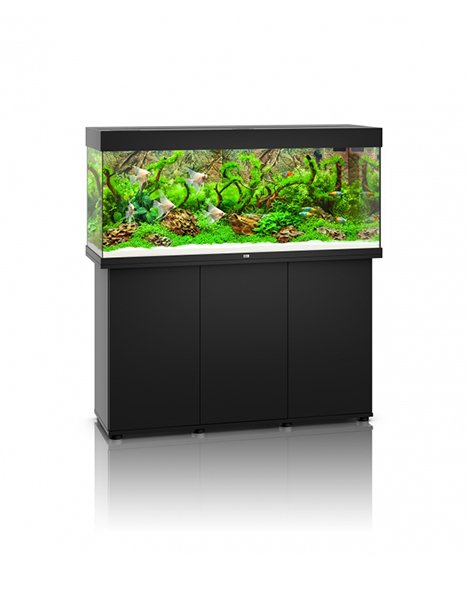
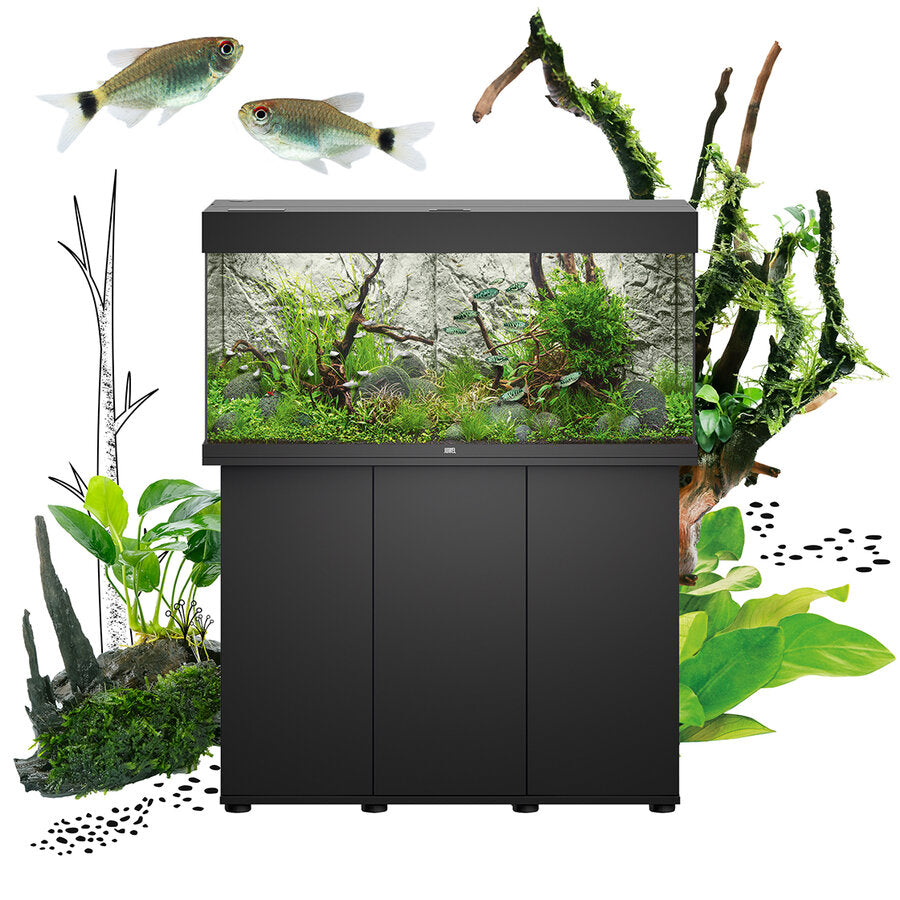
JUWEL Rio 180 LED Aquarium & Cabinet – Black
The JUWEL Rio 180 LED is a premium 180-litre complete freshwater aquarium designed for anyone wanting a proper-sized community or planted tank without moving into an enormous system.
At 101cm long, the Rio 180 gives you substantially more swimming and aquascaping room than a small starter aquarium while still fitting comfortably into most homes.
The system includes JUWEL's integrated Bioflow M filtration, Eccoflow 600 pump, AquaHeat Pro 200W heater and MultiLux LED lighting, with the matching black cabinet completing the setup.
For someone wanting a quality aquarium they can keep for years rather than quickly outgrow, the Rio 180 is one of our favourite sizes.
Why Choose the Rio 180?
The Rio 180 sits in a really useful sweet spot.
At 180 litres, you get:
-
Plenty of room for a proper tropical community
-
Enough length for schooling fish
-
Much more aquascaping space than a small starter tank
-
Greater water stability than a nano aquarium
-
Integrated filtration, heating and lighting
-
A clean matching cabinet
-
Equipment specifically designed to work together
-
Room to upgrade the lighting or filtration later if you want to take the aquarium further
It's large enough to build something impressive without becoming a massive aquarium that dominates the entire room.
What's Included?
The Rio 180 system includes:
-
180L JUWEL Rio aquarium
-
Matching SBX Rio 180 cabinet
-
Bioflow M internal filter
-
Eccoflow 600 circulation pump
-
Five types of filter media
-
AquaHeat Pro 200W heater
-
MultiLux LED 100 lighting system
-
DAY and NATURE LED tubes
-
Integrated aquarium hood and covers
That means the major equipment is already matched to the aquarium.
You still need things such as substrate, water conditioner, bacteria, décor, plants and livestock depending on the setup you're building.
Who Is It For?
We recommend the Rio 180 for:
-
Tropical community aquariums
-
Planted aquariums
-
Aquascapes
-
Larger schools of small tropical fish
-
Corydoras and other suitable bottom dwellers
-
Selected Gouramis
-
Livebearers
-
Smaller suitable cichlid setups
-
Customers upgrading from a small aquarium
-
Beginners who want to start with a decent-sized tank rather than immediately outgrowing a nano setup
For a first aquarium, 180L is not too big.
In many ways, we'd rather put a beginner into a sensible 180L setup than a tiny aquarium, because larger volumes are generally more forgiving when something changes.
Is 180L a Good Aquarium Size?
We think so.
The jump from a 40–70L aquarium to around 180L makes a surprisingly large difference.
You gain:
-
More stocking flexibility
-
More stable temperature
-
More stable water chemistry
-
More room for plants
-
More swimming space
-
Better schooling displays
-
More freedom when choosing hardscape
You also have room to make a mistake without every small change immediately affecting the entire aquarium.
The trade-off is simply that water changes involve more water and the aquarium needs a proper dedicated position in the room.
Bioflow M Filtration
The Rio 180 comes with JUWEL's Bioflow M internal filter.
The Bioflow system uses a large internal filter chamber with multiple types of filter media and an Eccoflow 600 pump, providing approximately 600 litres per hour of circulation.
It provides space for mechanical and biological filtration while keeping the filter completely inside the aquarium.
One advantage is simplicity:
There are no external filter hoses carrying water outside the tank.
For many customers, we'd simply keep the Bioflow filter and use it exactly as intended.
Should I Remove the JUWEL Internal Filter?
This is something customers ask us regularly.
For most people: no.
The Bioflow filter is a perfectly capable filtration system for the Rio 180.
We'd generally leave it in place unless you have a specific reason for wanting external filtration, such as:
-
A specialised aquascaping setup
-
Wanting more custom filter-media capacity
-
Wanting less equipment visible inside the display
-
Converting to a particular external-filter layout
If you're buying a new Rio 180, we'd run the included Bioflow first before deciding you need to tear it out and spend more money.
Important Filter Setup Tip
Before filling the aquarium completely, open the Bioflow filter and check all of the supplied filter media.
JUWEL packages some filter media inside protective plastic.
Remove all plastic bags and wrapping before operating the filter.
Yes, it sounds obvious.
And yes, people absolutely start filters with the media still sealed inside the plastic.
It happens more than you'd think!
JUWEL specifically instructs users to remove protective bags from media such as the carbon sponge, filter floss and Nitrax sponge before startup.
Don't Replace Every Filter Sponge at Once
JUWEL sells replacement media with recommended replacement intervals, but from a fishkeeping perspective we still want to protect the biological bacteria living throughout the filter.
We wouldn't strip the entire filter and replace everything at once unless there were a very specific reason.
Instead:
-
Replace disposable media where required
-
Clean reusable media as appropriate
-
Stagger major media replacement
-
Keep established biological media wet during maintenance
-
Don't scrub everything sterile every time you service the tank
Your goal isn't to make the filter look brand-new.
Your goal is to keep it working biologically and mechanically.
AquaHeat Pro 200W Heater
The included 200W JUWEL AquaHeat Pro sits within the Bioflow filtration system.
That means heated water is distributed through the filter's water flow rather than having a separate heater sitting somewhere random in the aquarium.
For a typical tropical community aquarium, this is a very tidy setup.
We still recommend using a separate thermometer so you can confirm the actual aquarium temperature rather than relying entirely on the heater setting.
MultiLux LED Lighting
The Rio 180 includes the JUWEL MultiLux LED 100.
It uses two replaceable LED tubes:
Together they provide broad-spectrum freshwater lighting designed to highlight fish and support aquarium plants.
One feature we particularly like is that the light unit can remain switched on while the aquarium flaps are opened for feeding or maintenance.
The lighting unit itself is waterproof and designed specifically for the Rio system.
Is the Standard Lighting Good for Plants?
Yes — for a normal planted aquarium, we'd start with the standard MultiLux LED before spending money upgrading it.
It is perfectly capable of growing many commonly kept aquarium plants, including:
-
Anubias
-
Java Fern
-
Cryptocoryne
-
Vallisneria
-
Amazon Swords
-
Hygrophila
-
Ambulia
-
Many common stem plants
If you're building a normal low-to-medium-tech planted tank, there's no need to assume the stock light immediately needs replacing.
When Would I Upgrade the Lighting?
We'd consider upgrading if you're specifically trying to build:
For that type of aquarium, a system such as the Chihiros WRGB Universal can make sense.
The important distinction is:
You don't need premium lighting just because premium lighting exists.
For a straightforward community/planted aquarium, we'd use the included system first.
Can I Keep the Lid Closed With Plants?
Yes.
The Rio is designed as a covered aquarium.
This helps:
That's one major difference between a Rio and an open-top rimless aquascaping tank.
Neither approach is inherently better — they simply suit different styles of aquarium.
What Fish Can I Keep?
A 180L aquarium gives you a lot of freshwater stocking flexibility.
Potential setups could include:
-
Large schools of Tetras
-
Rasboras
-
Guppies and other livebearers
-
Corydoras
-
Bristlenose Plecos
-
Gouramis
-
Rainbowfish appropriate for the tank size
-
Barbs
-
Selected dwarf cichlids
-
Various peaceful tropical community combinations
The exact stocking depends on adult fish size, behaviour and group requirements.
Don't fill a 180L aquarium simply by counting individual fish.
A school of 20 Neon Tetras has very different requirements from 20 large cichlids.
A Planted Community Setup We Like
If someone wanted a straightforward but impressive Rio 180, we'd think about something along the lines of:
Midwater:
A good-sized school of one or two small schooling species
Bottom:
A group of Corydoras
Feature Fish:
A suitable Gourami or another peaceful centrepiece species
Plants:
Cryptocoryne, Java Fern, Anubias, Vallisneria and some easy stem plants
That gives you movement at multiple levels without cramming the aquarium full of unrelated species.
Don't Add All the Fish on Day One
Even though this aquarium comes with filtration, the filter isn't biologically mature when you take it out of the box.
The aquarium still needs to establish beneficial bacteria capable of processing fish waste.
Our basic setup would be:
-
Assemble the cabinet and aquarium.
-
Install the filter media correctly.
-
Add substrate and hardscape.
-
Plant the aquarium.
-
Fill it with conditioned water.
-
Start the filter and heater.
-
Add beneficial bacteria.
-
Begin the cycling process.
-
Test ammonia and nitrite.
-
Add livestock gradually.
Don't mistake complete aquarium kit for instantly established aquarium ecosystem.
Use Prime, Stability & a Test Kit
For a new Rio 180, three products we'd normally want around are:
Seachem Prime
For conditioning tap water.
Seachem Stability
To help establish beneficial bacteria.
API Freshwater Master Test Kit
So you can actually monitor ammonia and nitrite rather than guessing whether the tank is cycled.
The test kit is the important part.
The aquarium doesn't become cycled because seven days passed on a calendar.
Cabinet Included
This Simply Fish Rio 180 Black package includes the matching JUWEL SBX Rio 180 cabinet.
The cabinet measures approximately:
101 × 41 × 73cm
and is specifically designed to support the Rio 180.
The cabinet also gives you storage underneath for:
-
Fish food
-
Water treatments
-
Test kits
-
Cleaning equipment
-
Spare filter media
-
Other aquarium supplies
Don't Put a Foam Mat Under It
This is important.
The Rio aquarium has its own safety base frame, and JUWEL specifically says not to put a separate mat underneath the aquarium.
The base frame is designed to distribute the load correctly.
Follow the manufacturer's setup instructions rather than automatically putting aquarium foam under it simply because that's common with some rimless glass tanks.
Make Sure the Cabinet Is Level
Before filling the aquarium:
-
Assemble the cabinet correctly
-
Position it on a solid surface
-
Check that it is level
-
Make sure it isn't rocking
-
Make sure the aquarium is properly seated
Once full, a Rio 180 system weighs well over 200kg once you include water, substrate, rock, aquarium and cabinet.
Choose the final position before filling it.
Moving a full aquarium is not the plan.
Specifications
Brand: JUWEL
Model: Rio 180 LED
Colour: Black
Aquarium Volume: 180L
Aquarium Dimensions: 101 × 41 × 50cm
Aquarium Empty Weight: Approximately 29.5kg
Filter: JUWEL Bioflow M
Pump: Eccoflow 600
Pump Flow: Approximately 600L/hr
Filter Media: Five media types supplied
Heater: AquaHeat Pro 200W
Lighting: MultiLux LED 100
LED Tubes: DAY + NATURE
Lighting: Replaceable LED tubes
Cabinet: SBX Rio 180
Cabinet Dimensions: 101 × 41 × 73cm
Cabinet Maximum Load: 350kg
Primary Use: Freshwater tropical and planted aquariums
Simply Fish Recommends
The Rio 180 is one of those aquariums where we think the size is almost more important than the brand.
Around 180 litres gives you enough space to build a proper aquarium without jumping to something enormous.
For someone buying their first serious tank, we'd happily recommend starting here rather than buying a tiny setup and wanting to upgrade six months later.
We'd also resist the urge to immediately modify everything.
Run the Bioflow filter.
Use the stock MultiLux lighting.
Get the aquarium established.
Learn what you actually want to change.
Then if you decide six months later that you're obsessed with aquascaping and want CO₂, WRGB lighting and an external canister filter, you can upgrade based on experience rather than buying equipment you may never need.
And before you turn that Bioflow on:
Take the plastic off the filter media.
We know we're repeating ourselves.
There is a reason.
FAQ
How many litres is the JUWEL Rio 180?
The aquarium has a nominal capacity of 180 litres.
What are the dimensions?
The aquarium measures approximately 101 × 41 × 50cm.
Does the Rio 180 include a filter?
Yes. It includes the JUWEL Bioflow M internal filter with an Eccoflow 600 circulation pump.
Does it include a heater?
Yes. A 200W AquaHeat Pro heater is included.
Does it include lighting?
Yes. It includes the MultiLux LED 100 with replaceable DAY and NATURE LED tubes.
Is the lighting suitable for live plants?
Yes. We'd happily use the standard lighting for many easy-to-moderate planted aquarium setups.
Do I need an external canister filter?
Not necessarily. The included Bioflow M is designed specifically for the aquarium and is perfectly suitable for many setups.
Should I remove the Bioflow filter?
We generally wouldn't unless you have a specific reason for switching to another filtration system.
Do I need to remove plastic from the filter media?
Yes. JUWEL packages some media in protective plastic that needs to be removed before the filter is operated.
Does the cabinet come with it?
This Simply Fish package includes the matching black SBX Rio 180 cabinet.
Should I put a foam mat under the aquarium?
No. JUWEL specifically advises against adding a separate mat because the Rio has an integrated safety base frame.
Is 180L too big for a beginner?
No. We actually like this size for beginners because the larger water volume provides more stocking flexibility and generally greater stability than very small aquariums.
Can I keep Neon Tetras in it?
Absolutely. A 180L Rio gives you enough room to keep a much more impressive school than a small nano aquarium.
Can I grow aquarium plants in it?
Yes. It's a very good size and shape for a planted aquarium.
Can I upgrade the lighting later?
Yes. You can move into higher-output planted aquarium lighting later if your goals become more demanding.
How long should I wait before adding fish?
Don't choose an arbitrary number of days. Establish the biological filter and use ammonia/nitrite testing to confirm what's happening before building up the livestock.