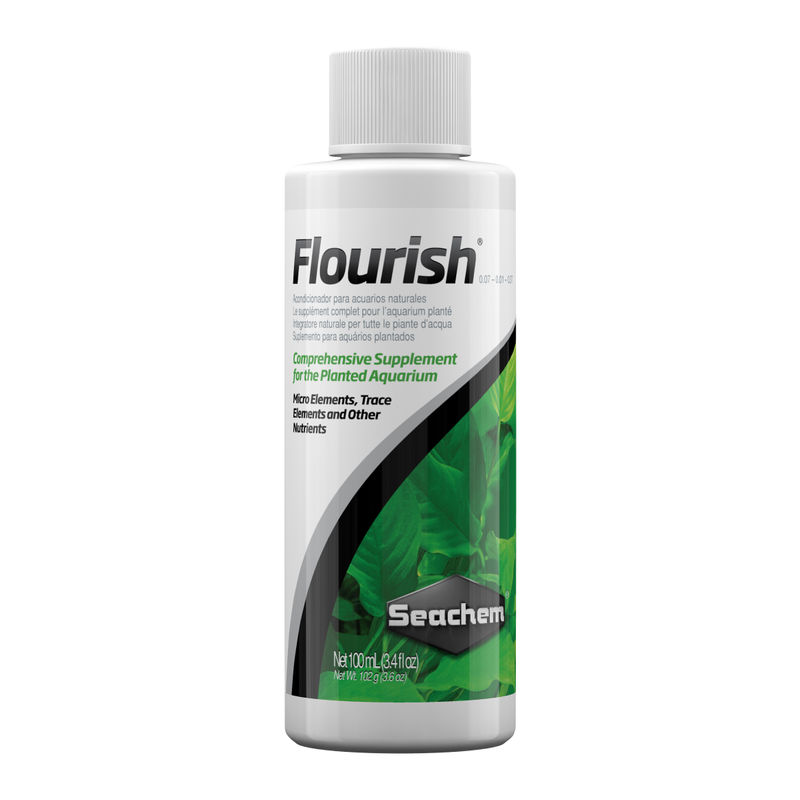
Seachem Flourish – Comprehensive Planted Aquarium Supplement
Seachem Flourish is a concentrated plant supplement for freshwater planted aquariums, providing important trace elements, micronutrients and other nutrients used by aquatic plants.
It contains nutrients including iron, calcium, magnesium, manganese and other trace elements that can become depleted as aquarium plants grow.
Flourish is a great foundation for straightforward planted aquariums, but it is important to understand what it is:
Flourish is primarily a micronutrient and trace-element supplement — it is not a complete high-dose nitrogen, phosphorus and potassium fertiliser.
Why Use Seachem Flourish?
Aquarium plants need more than light and water to grow properly.
As plants grow, nutrients are removed from the water and substrate. In aquariums with lots of plants, strong lighting or relatively low fish stocking, those nutrients can become depleted surprisingly quickly.
Flourish helps replenish a broad range of micronutrients and trace elements required for healthy plant development.
We recommend it for:
-
Freshwater planted aquariums
-
Beginner planted tanks
-
Community aquariums containing live plants
-
Low-to-medium-tech planted setups
-
Aquariums using inert sand or gravel
-
Tanks where additional trace-element supplementation is required
What Nutrients Does Flourish Provide?
Seachem Flourish contains a broad mixture of nutrients including:
-
Iron
-
Calcium
-
Magnesium
-
Manganese
-
Potassium
-
Boron
-
Zinc
-
Molybdenum
-
Other trace elements
These nutrients support processes involved in healthy leaf, root and overall plant development.
However, Flourish contains only relatively small amounts of the major plant nutrients nitrogen, phosphorus and potassium.
That distinction is important.
Is Seachem Flourish an All-in-One Fertiliser?
Not really.
This is probably the biggest misunderstanding we see with Flourish.
Flourish provides a broad range of micronutrients and trace elements, but it is deliberately not loaded with nitrogen, phosphorus and potassium.
If your aquarium is deficient in those macronutrients, you may also need:
-
Seachem Flourish Nitrogen
-
Seachem Flourish Phosphorus
-
Seachem Flourish Potassium
Whether you need those products depends on your aquarium.
A lightly planted tank with plenty of fish may receive significant nitrogen and phosphorus through fish waste and feeding.
A heavily planted, high-light aquarium can consume those nutrients much faster.
Don't automatically add every fertiliser bottle simply because it exists — look at your plants, stocking, water testing and overall setup.
Who Is Flourish Best For?
We particularly like Flourish for customers who:
-
Have started adding live plants to a community aquarium
-
Want a straightforward micronutrient fertiliser
-
Keep easy plants such as Anubias, Java Fern, Cryptocoryne and Vallisneria
-
Have stem plants showing increasing nutrient demand
-
Want to build a more complete planted-tank fertilisation routine
-
Are using sand or gravel and need additional water-column fertilisation
For an extremely heavily planted high-tech aquarium, we'd usually build a more complete fertilisation programme rather than expecting Flourish alone to supply everything.
How Do I Use Seachem Flourish?
Seachem's standard dose is:
5mL per 250 litres
Dose once or twice per week.
Shake the bottle before use.
For smaller aquariums, each thread inside the cap represents approximately 1mL, which makes smaller doses easier to measure.
Easy Dosing Guide
25L aquarium:
0.5mL
40L aquarium:
0.8mL
50L aquarium:
1mL
80L aquarium:
1.6mL
100L aquarium:
2mL
150L aquarium:
3mL
200L aquarium:
4mL
250L aquarium:
5mL
Dose once or twice each week depending on plant mass, growth and the rest of your fertilisation programme.
Which Bottle Size Should I Buy?
Simply Fish stocks several sizes.
100mL
Provides approximately 20 standard 5mL doses.
Great for nano tanks, smaller planted aquariums or someone trying Flourish for the first time.
250mL
Approximately 50 standard doses.
This is the size we'd choose for many normal home planted aquariums.
500mL
Approximately 100 standard doses.
Better value for larger tanks or customers who use Flourish regularly.
2L
Approximately 400 standard doses.
Best suited to large planted aquariums, multiple tanks, fish rooms or customers using significant quantities.
Because Flourish is highly concentrated, even the smaller bottles last quite a while on a modest aquarium.
Do I Need Flourish if I Have Fish in the Tank?
Potentially, yes.
Fish food and fish waste provide some nutrients — particularly nitrogen and phosphorus — but that doesn't necessarily mean every nutrient plants require is available in suitable amounts.
Flourish helps provide trace elements and micronutrients that may otherwise become depleted.
How much supplementation your tank actually needs depends on:
-
Number of plants
-
Number and size of fish
-
Lighting intensity
-
CO₂ availability
-
Substrate
-
Water-change frequency
-
Plant species
-
Growth rate
Do I Need CO₂ With Flourish?
No.
Flourish can be used in low-tech planted aquariums without injected CO₂.
However, light, carbon and nutrients all work together.
If you dramatically increase your lighting and fertilisation, plants may become more limited by available carbon.
Likewise, adding CO₂ to a tank with inadequate nutrients can create another imbalance.
You don't need to turn a straightforward planted tank into a laboratory — just remember that fertiliser is only one part of plant growth.
Flourish vs Flourish Excel
These are completely different products.
Seachem Flourish
Provides micronutrients, trace elements and other plant nutrients.
Seachem Flourish Excel
Provides a bioavailable organic carbon source.
They are not interchangeable.
Depending on your aquarium, both can form part of the same planted-tank routine.
Flourish vs Flourish Trace
Flourish already contains trace elements, but Seachem also makes Flourish Trace for replenishing trace elements that can be depleted relatively quickly.
If using both products, Seachem recommends dosing them on alternate days rather than together.
For most people starting a simple planted aquarium, we wouldn't immediately tell them they need every bottle in the Flourish range.
Start with what your aquarium actually requires and build from there.
Does Flourish Contain Iron?
Yes.
Flourish contains iron along with numerous other trace elements.
However, if you're running a heavily planted aquarium with particularly high iron demand, Seachem also makes Flourish Iron as a dedicated iron supplement.
Again, don't assume red plants automatically mean "pour in more iron."
Poor red colour can also relate to lighting, CO₂, plant species, general nutrition and overall plant health.
Can I Use Flourish With Root Tabs?
Absolutely.
They complement each other well.
Flourish primarily provides nutrients through the water column.
Root fertilisers such as Seachem Flourish Tabs provide nutrients directly around plant roots.
For heavy root feeders such as many Cryptocoryne and Sword plants growing in inert gravel or sand, we often like using both water-column and root fertilisation.
Storage
Seachem recommends refrigerating Flourish three months after opening.
Keep the bottle properly sealed between uses.
Don't panic if one bottle looks somewhat darker than another — Seachem notes that colour can naturally vary between batches without affecting the product.
Specifications
Brand: Seachem
Product: Flourish
Type: Freshwater planted aquarium supplement
Primary Purpose: Micronutrients and trace elements
Standard Dose: 5mL per 250L
Frequency: Once or twice weekly
Freshwater: Yes
Marine: No — intended for planted freshwater aquariums
Shrimp Safe: Yes, when used as directed
Simply Fish Sizes:
Simply Fish Recommends
Flourish is a product we like, but we'd rather customers understand what it does than simply pour it into every planted tank and hope for the best.
For a normal low-to-medium-tech community aquarium with some live plants, Flourish is a very easy starting point for regular micronutrient supplementation.
The biggest mistake is assuming:
“My plants look bad, therefore I need more Flourish.”
Plants can struggle because of:
So if you're already dosing Flourish correctly and your plants still aren't happy, we'd investigate what is actually limiting the plants before simply increasing the dose.
For a straightforward planted tank, we'd start with the manufacturer's normal dose once or twice weekly, watch the plants and adjust the wider fertilisation programme from there.
FAQ
What does Seachem Flourish do?
It provides a broad range of micronutrients, trace elements and other nutrients for freshwater aquarium plants.
Is Seachem Flourish a complete fertiliser?
It is a comprehensive plant supplement, but it does not provide significant amounts of nitrogen or phosphorus and contains relatively little potassium. Those macronutrients may need to be supplemented separately depending on your aquarium.
How much Flourish do I use?
Dose 5mL for every 250 litres once or twice each week.
How much Flourish do I use in a 100L tank?
Approximately 2mL per dose.
Do I need Flourish if I use aquasoil?
Potentially. Aquasoil can provide substantial root-zone nutrients, but water-column fertilisation may still be useful depending on the substrate, plant species and age of the aquarium.
Can I use Flourish with CO₂?
Yes.
Can I use Flourish without CO₂?
Yes. It's perfectly suitable for low-tech planted aquariums.
Is Flourish safe for shrimp?
Yes. Seachem states that Flourish is safe for shrimp when used as directed.
Does Flourish contain copper?
It contains a very small amount of copper as an essential trace element. Seachem states that the concentration at normal dosing is safe for shrimp and other aquarium inhabitants.
Does Flourish affect aquarium pH?
Seachem states that it will not alter pH when used as directed.
Should Flourish be refrigerated?
Seachem recommends refrigeration three months after opening.
Can I use Flourish and Flourish Trace together?
Yes. Seachem recommends dosing them on alternate days.
Can Flourish cause algae?
Correct fertilisation alone isn't automatically responsible for algae. Algae problems are usually related to the overall balance between lighting, plant growth, nutrients, CO₂ and maintenance. Avoid massively overdosing fertiliser and address the aquarium as a complete system.
Why are my aquarium plants still dying even though I use Flourish?
Fertiliser is only one variable. Check lighting, CO₂, macronutrients, substrate, planting technique and whether the plants are still adapting from emersed to submerged growth.